
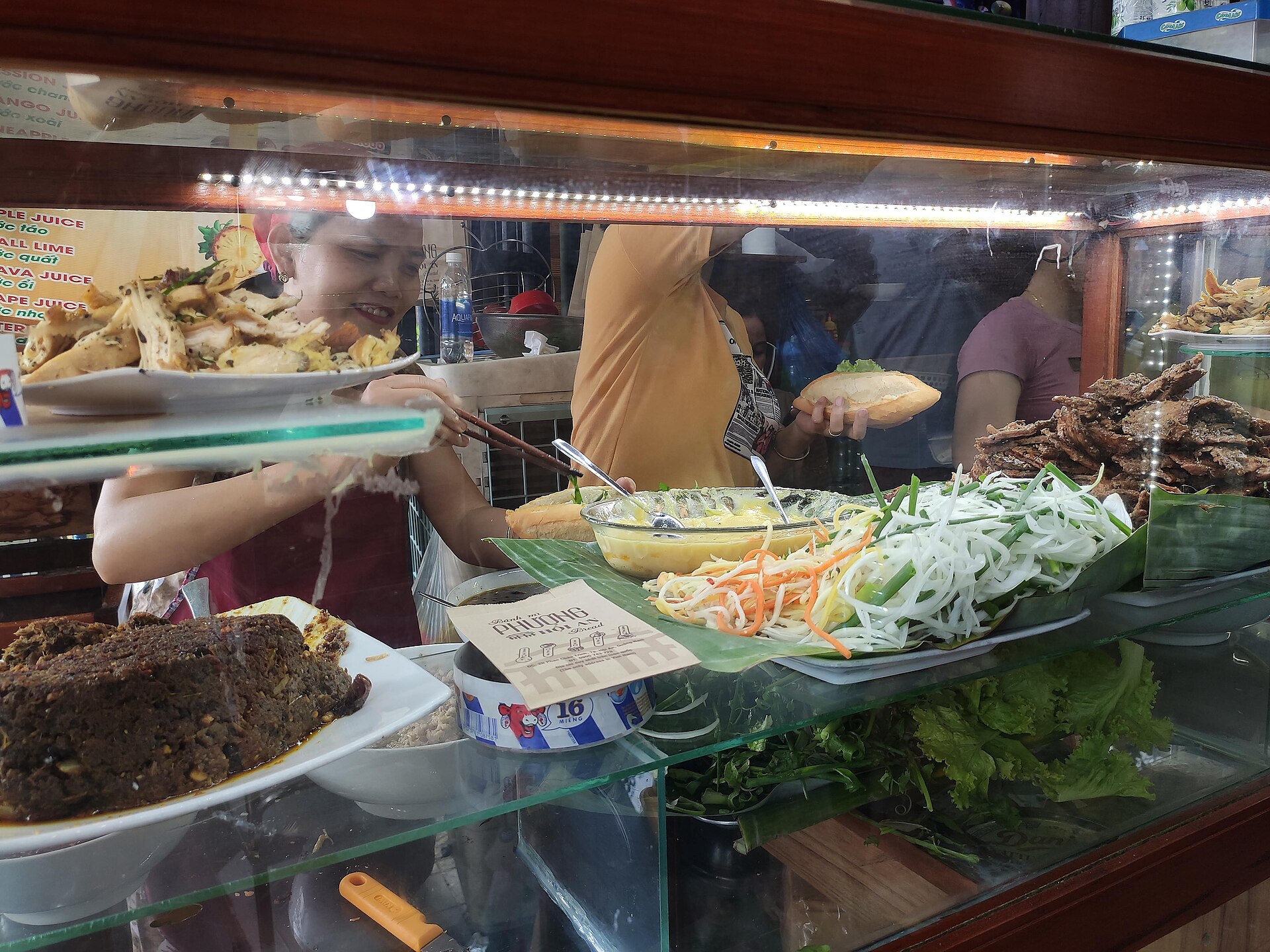
A loaf the size of a fist
No document says when the first loaf reached Hội An. The earliest trace is a memoir, and it concerns breakfast. Around 1944 or 1945, people in Hội An knew mạc nạm, a beef stew made from the cut called bạc nhạc. It resembled bò kho, but the method and the seasoning were quite different.
The memoirist Minh Hương, in Hội An quê tôi (Memories of Hội An, 2000), recalled that in the 1940s people ate mạc nạm with a loaf called bánh mì con cóc, "toad bread". The heritage-centre article adds that the loaf was the size of a fist, a little larger than an adult's, and sold for one xu to one and a half, depending on size. A xu was a hundredth of an Indochinese piastre.
Elsewhere the bread is older. AFP quoted the food historian Erica Peters, author of Appetites and Aspirations in Vietnam. By 1910, she said, small baguettes sold in the street to Vietnamese on their way to work. AFP added that most French who came to Vietnam did not want low-level jobs such as baking, so Chinese and Vietnamese worked in the bakeries. Peters was not speaking of Hội An in particular. For the town, the earliest trace with a name attached is still that breakfast.
The ovens in Thông's telling
The account of the first ovens comes from Thái Tế Thông, whom the town called Mr Chảy. According to him, Hội An had a bread oven before 1945. It belonged to a Chinese man known as Mợ Phu, of the Gia Ứng congregation.
After 1945, he said, an oven called Quân An, run by Mang Chược, did so well that its owner bought the Thông family's house on Trần Phú Street and built another workshop.
A worker in Mợ Phu's oven named Xường had been a soldier from Yunnan, stranded in Hội An. He learned the trade there and opened an oven of his own in the house beside the Quảng Triệu assembly hall. Around the same time Bùi Thị Trung ran an oven in Sơn Phong district, near the town's power plant. Thông said it opened in 1947 and worked for about ten years.
Four ovens and a stranded soldier, all known through Thông's recollection.
The electric oven from Đà Nẵng
After 1960 Hội An had two electric bread ovens, baking with American flour. Thông remembered the day the Hoàng Hiệp trading house brought its electric oven from Đà Nẵng. For the town it was an event, and people came to watch.
Thông knew some army engineers, which was how he borrowed a vehicle to carry the oven into town. Rails went down to bring it into the house.
Around 1970, Lê Châu recalled, Hội An had two ovens: Hoàng Hiệp's, and one belonging to a Mr Lang. Hoàng Hiệp's owner was Hứa Thiên Phước, known as Mr Hột, whose house stood a few doors from Châu's. When he opened, he invited Châu's father, then headmaster of the boys' school in Hội An, to collect the loaves of the first batch as a mid-morning snack for the pupils. Every morning, opening his door for school, Châu smelled the bread from the Hoàng Hiệp oven.
The rails are Thông's story and the schoolchildren are Châu's. The article does not say whether that opening day was the day the electric oven arrived.
Ovens on the edge, stalls at the crossroads
When the ovens in the old quarter closed, many ovens on the edge of town came into being. The article singles out one, the 304 bakery, run by the family of Võ Thị Tuấn. It says the bakery employed many experienced workers and supplied bread to stalls at street crossroads and to well-known shops in Vietnam and abroad, among them Madam Khánh and Phượng. It gives no year.
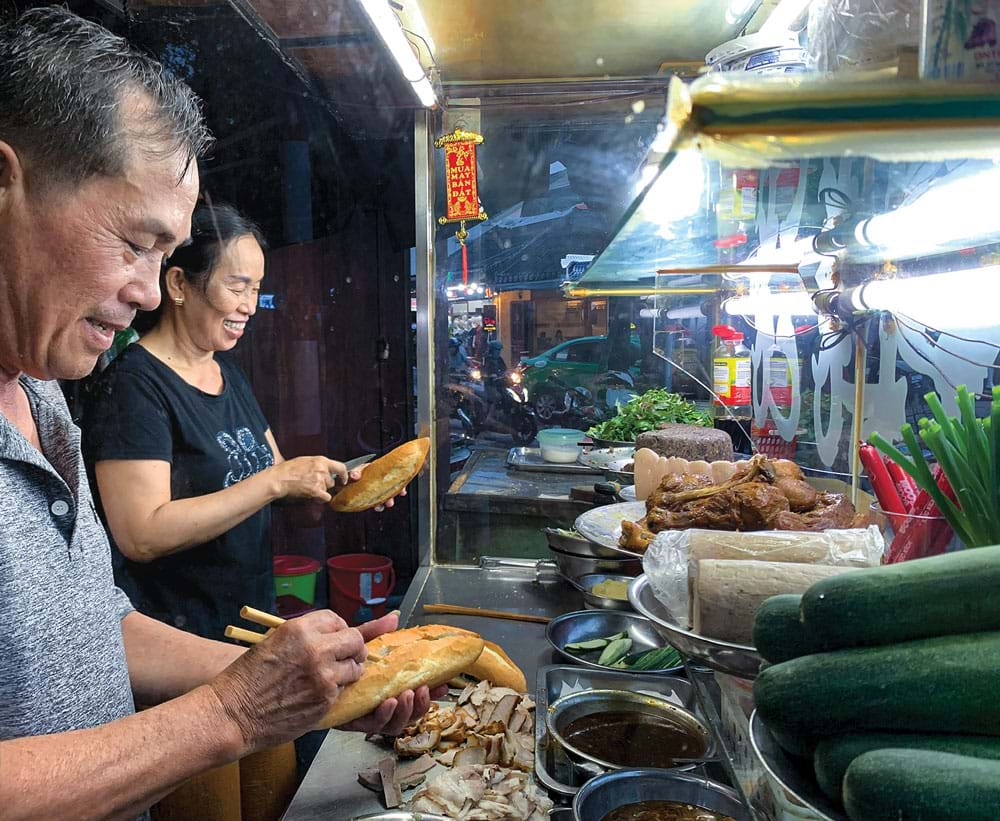
At the crossroads, small stalls drew most of Hội An's bánh mì devotees. Mrs Lành, who had kept hers for more than thirty years, told the author that she still got up at four or five in the morning to prepare the pork and the sauces herself. The pork took dozens of spices in its marinade and simmered over a low flame. The author noticed that the sellers seemed to remember each customer's taste.
Early in the morning customers were in a hurry, yet hardly anyone hurried the seller.
The street-food list
A 2016 article in the heritage centre's bulletin summed up recollections of street food in the old quarter. Before 1945 there was little of it. A few sellers carried things round the streets, items such as pulled candy, sticky candy, peanut candy, sugar cane, sweet soup and fertilised duck eggs.
By the early 1960s, witnesses at a community consultation on street trading named mì quảng, cao lầu, bún, curry, phở, wonton, bánh xèo, sweet soup and tea. Bánh mì was not on that list. The article does not say why, and a list from witnesses is not a complete one.
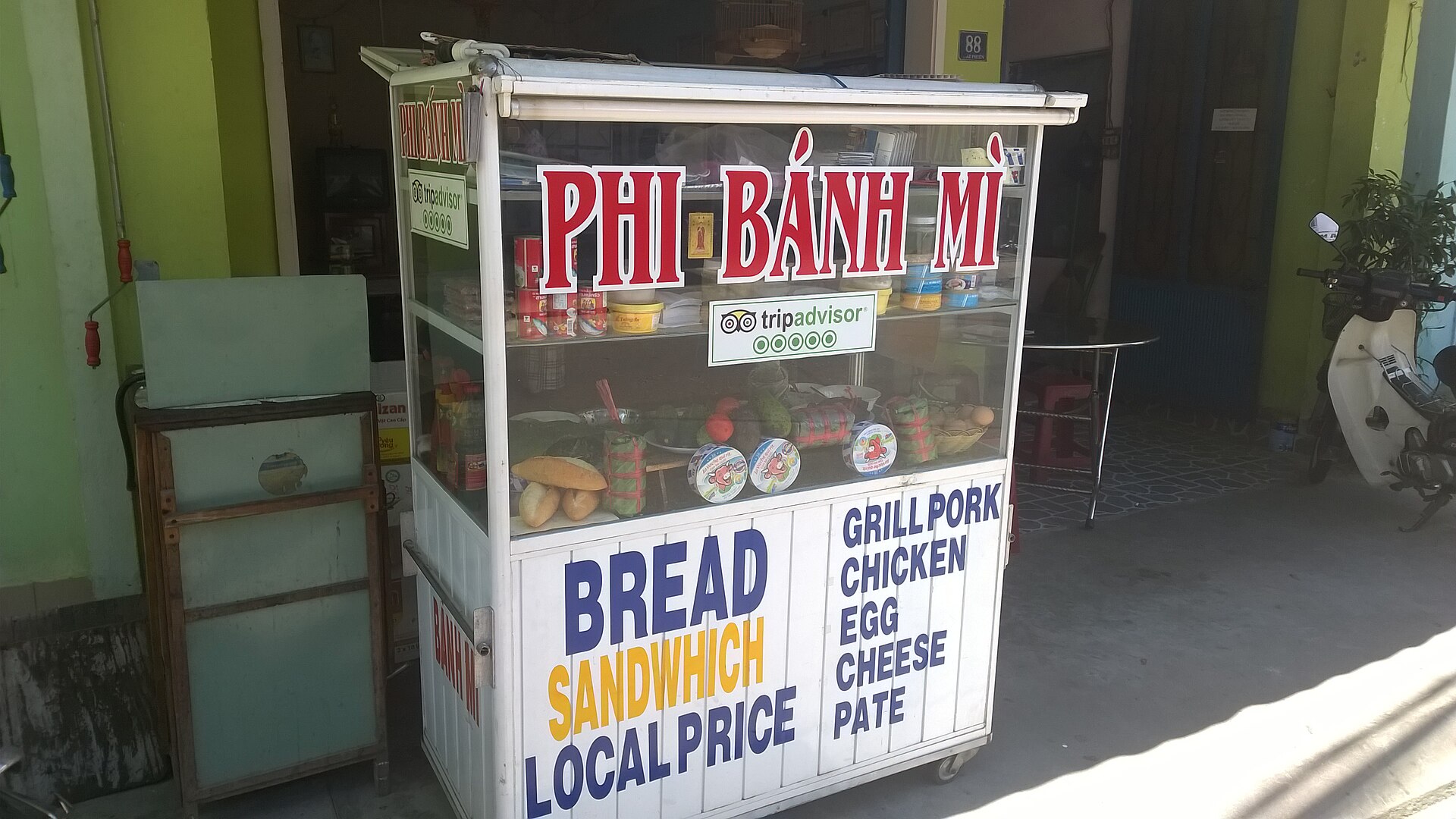
In 2016 the author listed the main street foods of the old quarter as bún, mì quảng, grilled meat, sweet soup, bánh bèo, bánh da lợn, bánh đậu xanh and bánh mì.
Bánh mì is absent from the early-1960s list and present on the list of 2016. The article does not measure the gap between them.
A dessert seller opens a bread shop
According to VICE in 2015, Nguyễn Thị Lộc took her first job at twenty, selling sweet bean soup. During the war she could sell only from home. Afterwards she carried the soup on a pole with a basket at each end, then settled at home again and began her bread business in 1985. VICE added that the bread she sold was baked in Hội An every morning.
Her husband was Bùi Văn Khánh. VICE reported that she was called Madam Khánh, borrowing his name, though she never took it. She told Vietnamnet that the English name of the shop came from foreign visitors. She spoke neither English nor French, and interpreters who travelled with tour groups told her it meant queen of bánh mì. A saying in the town lists famous stalls, and one line of it reads "bánh mì bà Khánh", Mrs Khánh's bread. On the kitchen wall, where she fried eggs every day, hung about a hundred handwritten notes from foreign customers.
Two minutes on screen
In 2007 the American chef Anthony Bourdain was told about a bread stall in Hội An's market. He stopped by, and came back two years later with a film crew, according to Tuổi Trẻ. The segment in No Reservations ran about two minutes. He ate with his friend, the restaurateur Philippe Lajaunie, and said: "That's a symphony in a sandwich." Vietcetera places the episode, season five, episode ten, in 2009.
About a year after the filming, Tuổi Trẻ wrote, foreign visitors crowded the stall. Its owner, Trương Thị Phượng, said she did not understand why. She was glad people filmed her stall but did not know who he was. The internet was not widely used then, and she learned what had happened only when a relative studying abroad told her she had appeared on a famous American programme.
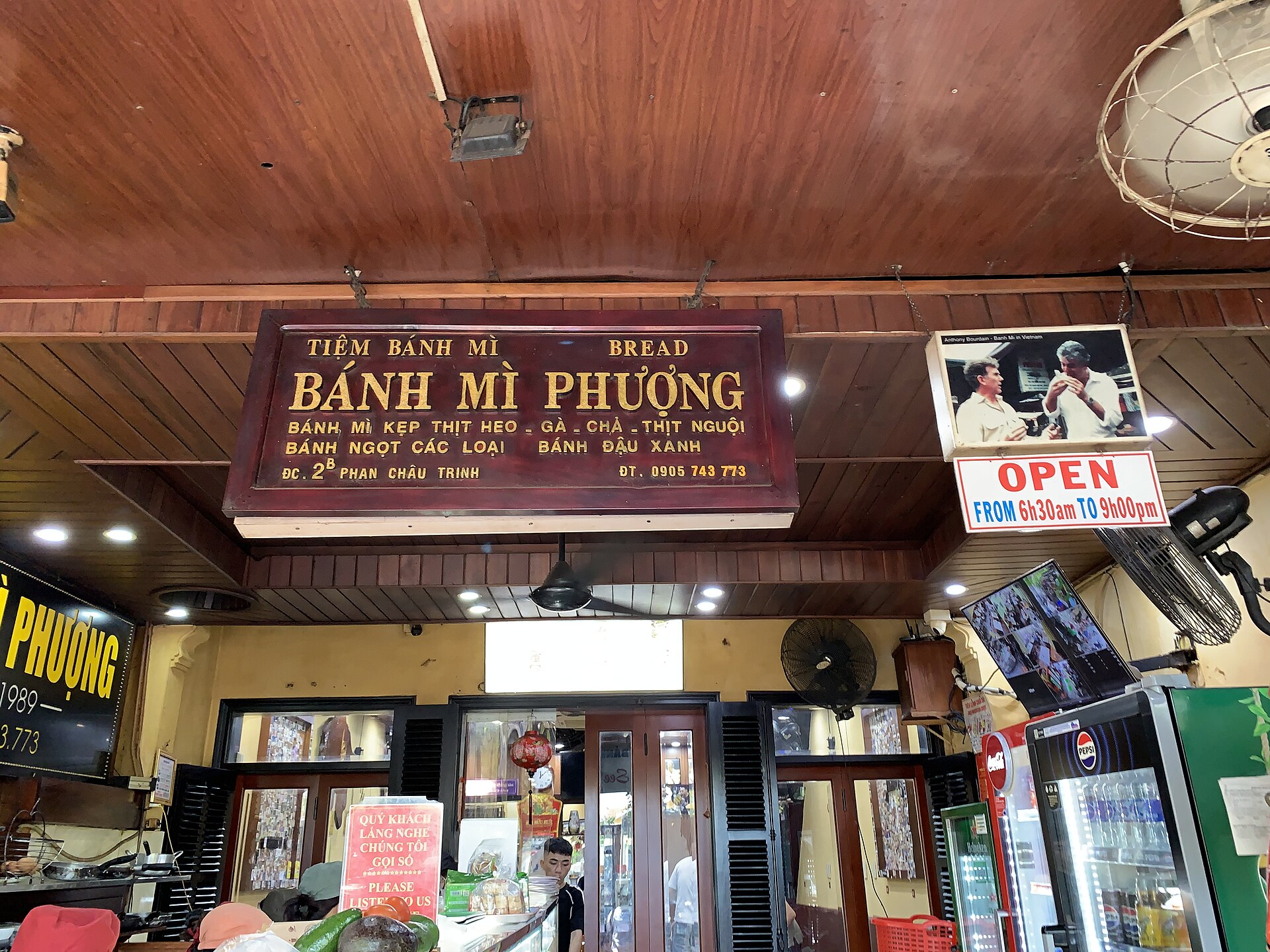
According to Tuổi Trẻ, after more than a decade she moved from the market stall to a larger shop on Phan Châu Trinh Street. At its entrance she hung a photograph of Bourdain and Lajaunie eating bánh mì at her old stall. She said that before Bourdain died in 2018 the two men came back a few times.
Beyond the town
In 2014 the travel and food writer David Farley went to Vietnam on a BBC assignment and ate about fifteen bánh mì in two weeks. In Hanoi he found a minimalist version with few fresh herbs. In Hội An, Saigoneer summarised, the herbs went in liberally. The sandwich he ate there had high-quality pork, two pork-based sauces, and a few surprises such as tomato and pickled papaya.
On 24 March 2011, Google says, the term bánh mì was admitted to the Oxford English Dictionary.
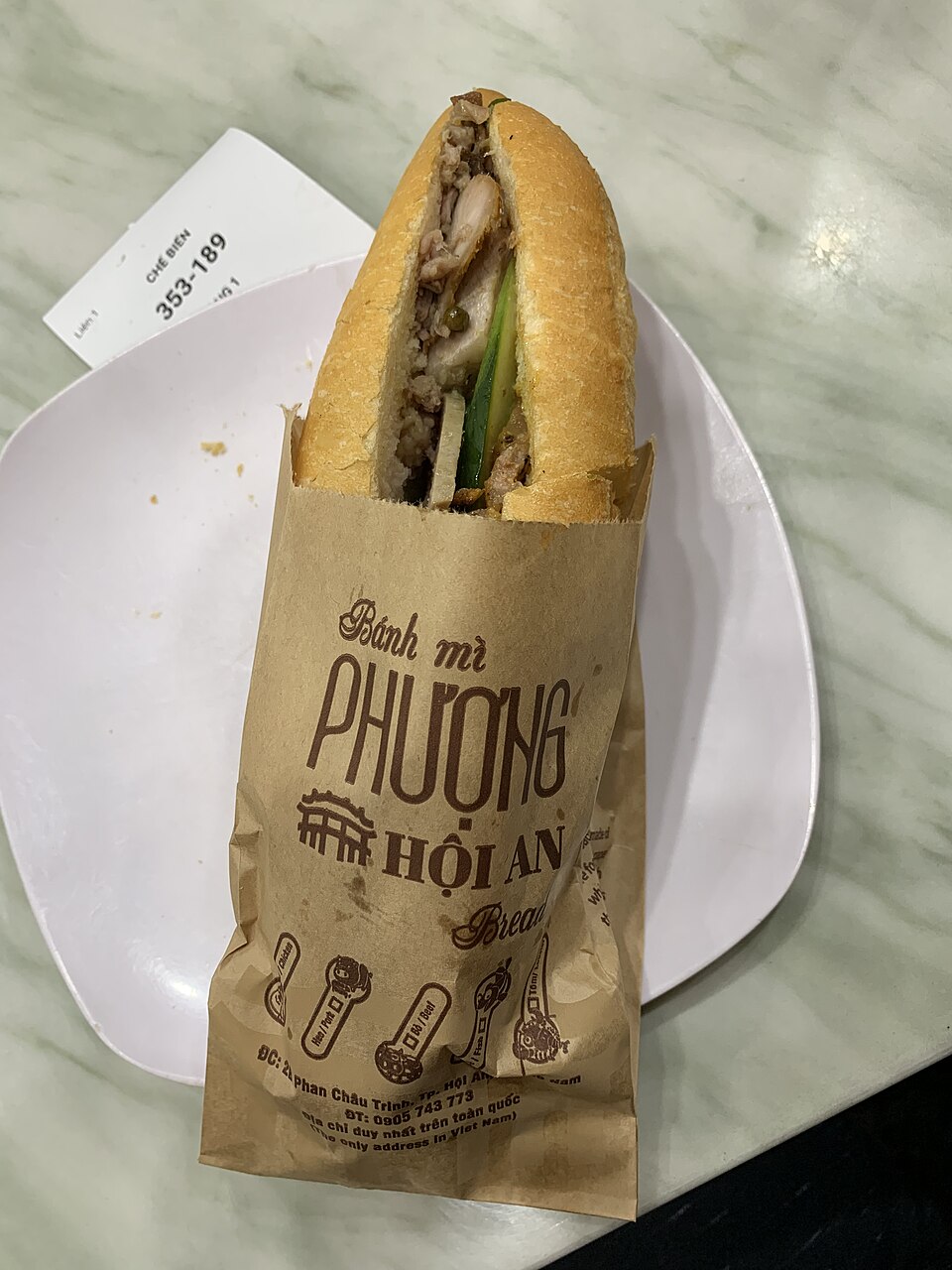


_-_img_01.jpg)
_-_img_04.jpg)
In May 2019 a shop called Bánh mì Phượng opened in Seoul's Yeonnam-dong district, run by a South Korean franchisee. Trương Thị Phượng spent ten days there beforehand training the cooks. The Hội An menu offered many fillings, the Seoul one only four. Asked why she chose Seoul, she said Korean visitors made up about 40% of her customers in Hội An.
In the town itself, the author of the heritage-centre article recorded, local people ate at that shop less often as the queues grew. She asked whether the people of Hội An were making room for visitors from afar, or staying loyal to the old flavour. She did not answer.
- Khiếu Thị Hoài, "Bánh mì phố Hội" — Thông tin nghiên cứu bảo tồn di sản số 61 (2023), bản trực tuyến của Trung tâm Quản lý Bảo tồn Di sản Văn hóa Hội An
- Khiếu Thị Hoài, "Bánh mì phố Hội" — bản đăng lại kèm chú thích cuối bài, Người Đô Thị, 09/06/2023
- Khiếu Thị Hoài, "Rủ nhau ăn bánh mì phố Hội" — Thể thao & Văn hóa 16/02/2018, đăng lại trên hoianheritage.net
- Trần Thị Lệ Xuân, "Ẩm thực vỉa hè ở khu phố cổ Hội An" — Thông tin nghiên cứu bảo tồn di sản số 03(35), 2016
- "Meet the Bánh Mì Queen of Hoi An" — MUNCHIES (09/2015), VICE (22/12/2017)
- Hạnh Nguyên, "Những ông lão, bà lão U80 Việt Nam nổi danh toàn cầu" — Vietnamnet, 05/07/2015
- Truong Trung, Dong Nguyen, "How Anthony Bourdain changed fate of 'banh mi' stall in Vietnam's Hoi An" — Tuoi Tre News, 04/08/2023
- "Every episode Anthony Bourdain filmed in Vietnam, ever" — Vietcetera, 08/12/2021
- "Hoi An's Banh Mi Phuong Opens First Overseas Branch in Seoul" — Saigoneer, 2019
- "Is Bánh Mì The Best Sandwich In The World?" — Saigoneer, 16/10/2014, tóm lược bài của David Farley trên BBC
- "Beyond the baguette: France's food legacy in Vietnam" — AFP, đăng lại trên Tuoi Tre News, 04/09/2016
- "Celebrating Bánh Mì" — Google Doodles, 24/03/2020
- Banh My Phuong Hoi An quay banh.jpg — DangTungDuong, CC BY 4.0
- Bánh mì phố Hội — Khiếu Thị Hoài / Trung tâm Quản lý Bảo tồn Di sản Văn hóa Hội An, Bản quyền tác giả
- Phi Banh Mi bread stand in 2015.jpg — Vuong Tri Binh, CC BY-SA 4.0
- Bánh Mì Phượng (2024) - img 01.jpg — Chainwit., CC BY 4.0
- Bánh Mì Phượng (2024) - img 04.jpg — Chainwit., CC BY 4.0