_01.jpg)
A General Who Lost
Guan Yu commanded troops during the Three Kingdoms period in China, fighting for the house of Han against the kingdoms of Wu and Wei. His courtesy name was Vân Trường. A 2012 newspaper account gives his dates as AD 160 to 219: defeated by the forces of the rival warlord Sun Quan, he was put to death in 219. Later rulers kept adding to his record. In 1725, the Yongzheng Emperor of the Qing ordered martial temples raised to him across the empire, worshipped with rites reserved for Confucius. Eleven years later, the Qianlong Emperor granted him the title Sơn Tây Quan Phu Tử — Phu Tử, Master, a title only Confucius had held before him. The temple in Hội An was already standing when both decrees were issued: it predates them by more than seventy years, and neither decree built it.
Before Khánh Đức Quý Tỵ
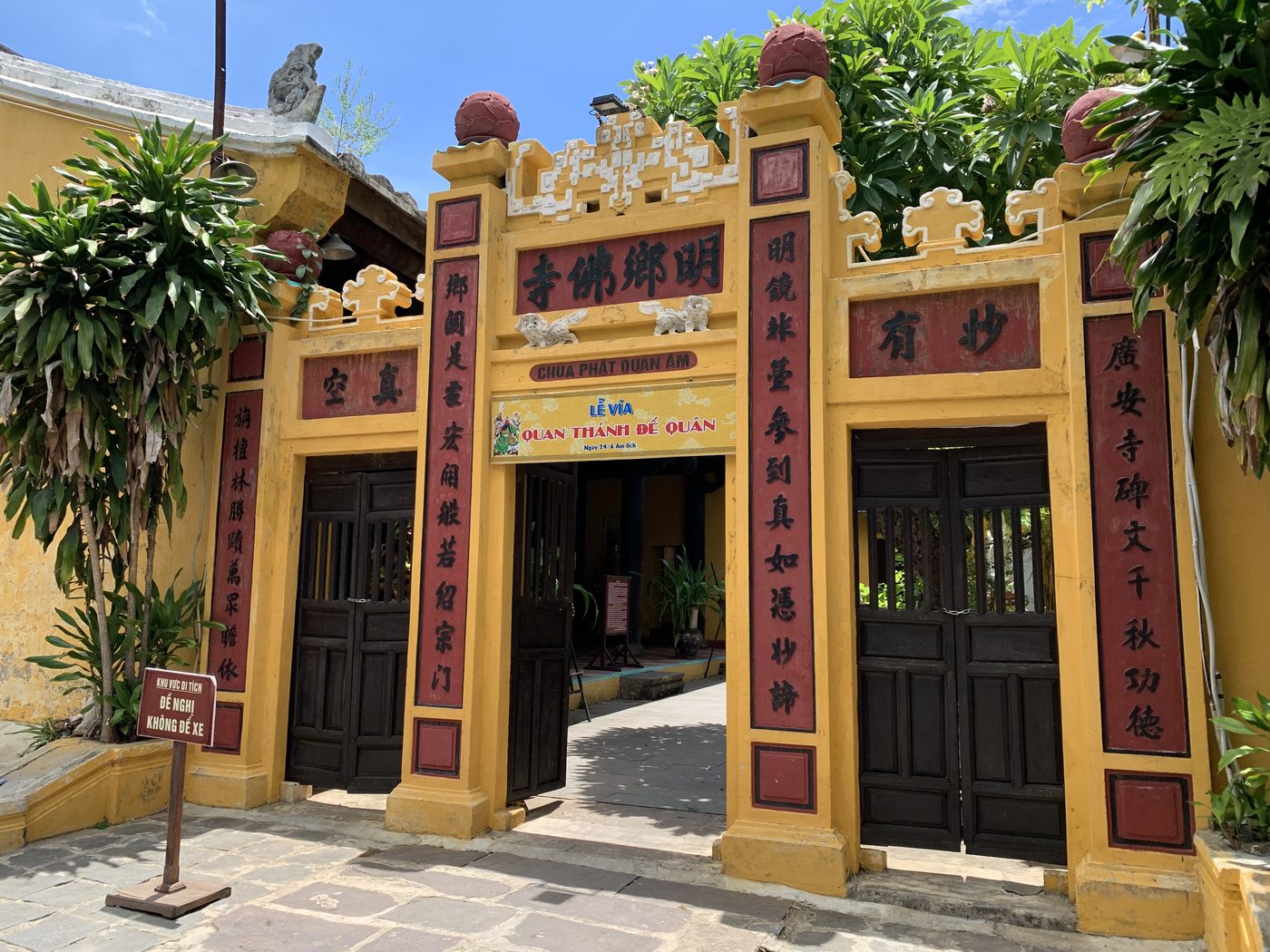
Before the year Khánh Đức Quý Tỵ, 1653 on the Gregorian calendar, a temple to Guan Yu stood in the middle of the port town. The date comes from a plaque of investiture inside, inscribed that winter and still hanging there when the researcher Chiung Wi-vun saw it in 2012. Accounts differ on who built it: the Hội An heritage centre credits the Minh Hương community and the Vietnamese of the town together, while the historian Chen Ching-ho, writing in 1962, credited the Minh Hương alone. The site stood, and still stands, opposite the town market, at what is now 24 Trần Phú street. Hội An people gave the temple three names. They call it Chùa Ông, the Lord's pagoda: chùa is the word for a Buddhist temple, and Hội An gives it to any shrine it holds in comparable regard. The records call it Quan Công Miếu. Its formal name, in three Chinese characters, is Trừng Hán Cung, 澄漢宮. Three names, one place of worship.
A Poem Under a Trịnh Banner
Vietnam was then split between two houses: the Trịnh lords ruled the north in the name of a Lê emperor, and the Nguyễn lords ruled the south, Đàng Trong, from their capital at Phú Xuân. Since 1771 a third force, the Tây Sơn, had risen against the Nguyễn, and in 1774 they took the south-central coast. The Trịnh court saw its chance. Hoàng Ngũ Phúc marched south as commander-in-chief, with Nguyễn Nghiễm serving as General of the Left over an army of thirty thousand. Early in 1775 the Trịnh army took Phú Xuân, the Nguyễn lord fled south, and Trịnh troops pursued him into Quảng Nam, fighting Tây Sơn forces on the ground in Hội An itself. After the fighting, Nguyễn Nghiễm visited the Quan Công temple. He was the father of Nguyễn Du, who would later write the poem The Tale of Kiều, and he would die within the year. Standing before the temple, he composed two poems in Chinese, comparing his own campaign to restore the Lê court to Guan Yu's loyalty to the house of Han. Two officers in his train, Uông Sĩ Dư and Nguyễn Lệnh Tân, each wrote one poem in reply. Trần Tử Quang, who transcribed all four for the newspaper Dân trí in 2012, found them still legible: three wooden boards, hanging before the sanctuary where they were first placed, more than two hundred years on.
One Altar, Many Figures
Inside the main hall, Guan Yu does not sit alone. Beside him stand Quan Bình, his adopted son, and Châu Thương, his loyal lieutenant. Two life-sized horses flank the altar, a white one on the left and, on the right, Xích Thố, the horse the rival warlord Cao Cao once gave him. Side altars hold Confucius and a figure known as Chúa Tiên.
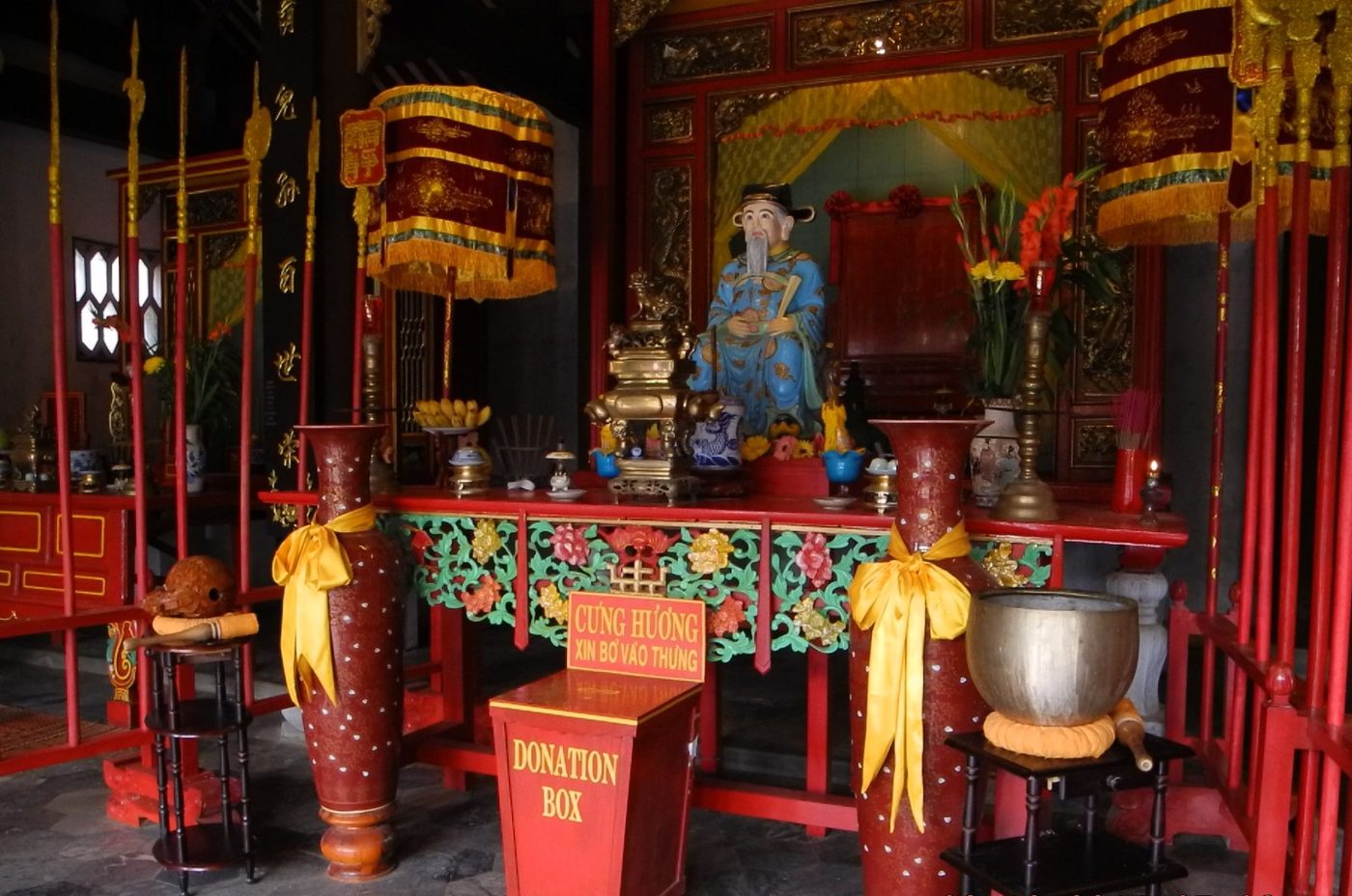 Photograph · Franzfoto · Wikimedia Commons · CC BY-SA 3.0
The Nguyễn dynasty, which unified the country from Huế in 1802, took the cult up on its own account. It ordered temples to Quan Công built in twenty-three provinces and issued edicts for his worship. His sacred title ran to a long string of honorifics, too long to say in one breath: Quan Thánh Đế Quân Hộ Quốc Tí Dân Hiển Hữu Công Đức Dực Bảo Trung Hưng Đại Vương Tôn Thần. The Hội An temple was by then one shrine among twenty-three, and the god inside it carried a title granted from Huế.
Three Hundred Lạng of Silver
In 1825, Emperor Minh Mạng toured Quảng Nam province. Before he set out, he issued his own instruction for the journey: inspect local officials, and bring favour to the people. Hội An, he added, was poorer than in the past but remained a place where people still lived and traded. The chronicle Đại Nam thực lục records the day his procession reached Hội An: he remitted half the tax owed by the Minh Hương community, then ordered silver distributed to two temples in the town. The Quan Công temple received three hundred lạng of silver, the Vietnamese tael. The Thiên Phi temple received one hundred. The same entry has him renaming a newly built pagoda in Hải Châu Chính and ordering the provincial office to cut its name-board. Read against his own instruction, the silver was policy, not courtesy. From that year, the temple that Minh Hương and Vietnamese townspeople had built together carried the court's own recognition.
Five Stelae, Two Without a Year
Five stone stelae survive inside Trừng Hán Cung. The two oldest carry no imperial reign name at all, only the era name Long Phi, an invented reign name that Ming loyalists and their Minh Hương descendants used in place of the ruling Qing emperor's. The other three are dated: the eighth year of Minh Mạng, 1827, the seventeenth year of Tự Đức, 1863, and the sixteenth year of Thành Thái, 1904. Chiung Wi-vun, a professor at National Cheng Kung University in Taiwan, read all five during three seasons of fieldwork between 2012 and 2014. His conclusion: the people responsible for these repairs, generation after generation, were mostly Minh Hương, not newly arrived Chinese traders.
Four Wings in the Shape of a Mouth
The temple follows the shape of the Chinese character khẩu, 口, a mouth, which is to say a square: four wings enclosing an open-air courtyard, a front hall, two side wings and a main sanctuary at the rear. Builders laid its roof with tube tiles glazed green. The heritage centre's dossier dates the temple's present form to a nineteenth-century restoration. The two leaves of the main door carry a pair of green dragons, carved in relief, coiled in cloud. The Vietnamese Wikipedia entry, citing a printed guide, gives a bronze bell inside weighing over half a tonne, and a large drum on a wooden stand said to have been a gift from Emperor Bảo Đại.
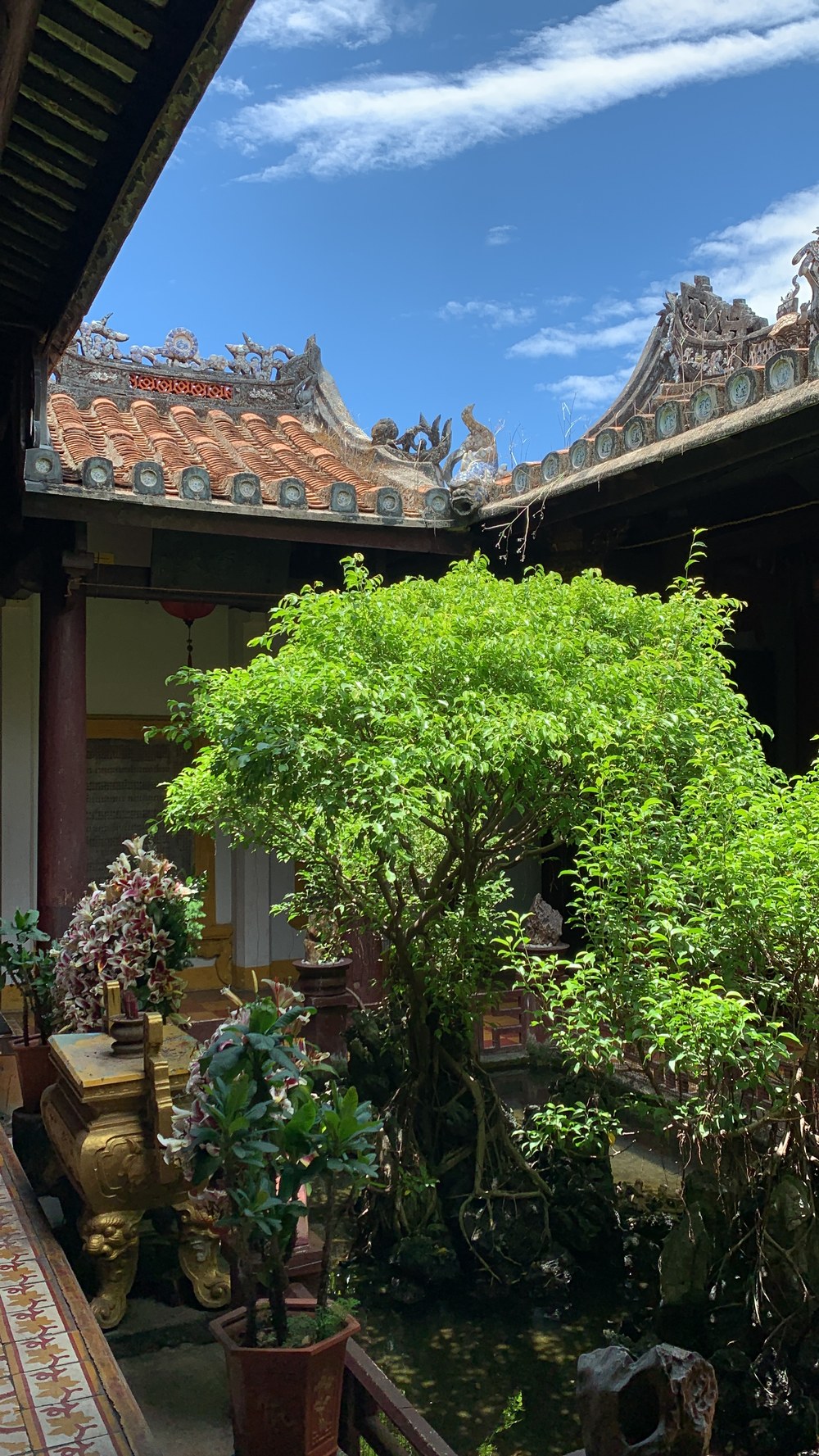 Photograph · Chainwit. · Wikimedia Commons · CC BY 4.0
At the centre of the four wings, the open courtyard holds a miniature rock garden, daylight falling straight down between the surrounding roofs.
Nationalised, and Not Returned
In 1975, the country was reunified. Trừng Hán Cung passed into state management, and so did Tụy Tiên Đường next door at 14 Trần Phú, the hall where the Minh Hương honour their founding ancestors. Before then, a council of Minh Hương elders had cared for Trừng Hán Cung and organised its rites. The council stopped meeting after reunification, and Minh An ward closed the temple's doors. After the reforms of Đổi Mới, the state handed Tụy Tiên Đường back to a Minh Hương committee. Trừng Hán Cung it kept. A member of that committee told the researcher Chiung Wi-vun why: the number of worshippers, and the income the temple's offerings brought in. In 1987, the Hội An Monuments Management and Tourism Service Board reopened it officially. Since 1997, the Hội An Centre for Cultural Heritage Management and Preservation has run the temple and organised its festivals.
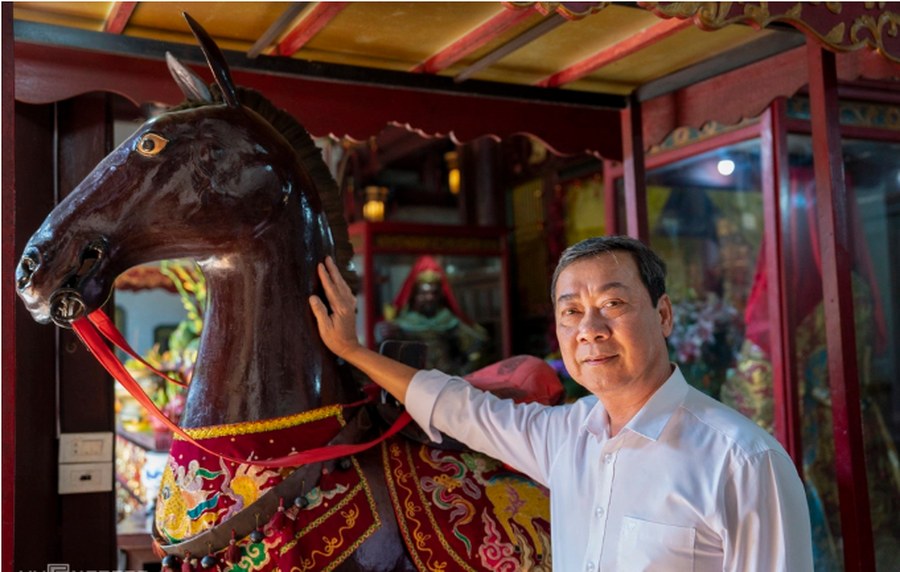 Photograph · Nguyễn Đông / VnExpress
192 Household Altars
Not everyone who worshipped Quan Công went to the temple. A 1982 survey counted 192 household altars to him inside private homes across the town. Each trade had its own reason for the devotion. Merchants worshipped him as a god of wealth, because the story tells that in his poorer years he had sold bean curd for a living. Scholars worshipped him as a god of letters: the statue in the main hall shows him stroking his beard with one hand while the other holds the Spring and Autumn Annals, the Confucian chronicle, open. Soldiers worshipped him as a guardian spirit, for his skill as a general. One deity, divided among trades. Nine years after that survey, on 29 November 1991, the temple was formally listed as a national historical and cultural relic.
Across From the Market
The temple stands directly across from the Hội An market. Chiung Wi-vun's informants drew the line the other way: because the temple faces the market, that is where disputes went. The heritage centre's account, passing on what the town says, has merchants selling whole shiploads on credit on the strength of an oath sworn here. Chiung, conducting fieldwork between 2012 and 2014, recorded the words of two residents, one Minh Hương and one third-generation ethnic Chinese: many trade disputes, they told him, still go before Quan Công for settlement. Worshippers today are not sorted by ancestry — Vietnamese, Minh Hương and ethnic Chinese all burn incense at the same altar. Not far away, at the Cantonese assembly hall, the later Chinese settlers keep their own altar to the same god. One deity, two houses, two generations of newcomers.
The Twenty-Fourth of the Sixth Month
Every year, on the twenty-fourth day of the sixth lunar month, Hội An holds a festival for Quan Công. Three rounds of gong and drum open the rite, and attendants lay a whole roast pig, a tray of glutinous rice and a tray of steamed buns before the altar. The chief celebrant, in wide robes and sash, kneels and bows as two callers, east and west, announce each step. When the cue comes to read the prayer, attendants bring the text down from the altar, written in Chinese characters on yellow paper, and a reader recites it aloud, then burns it. A lion dance follows, to pay respect to Quan Công and lift the mood of the crowd.
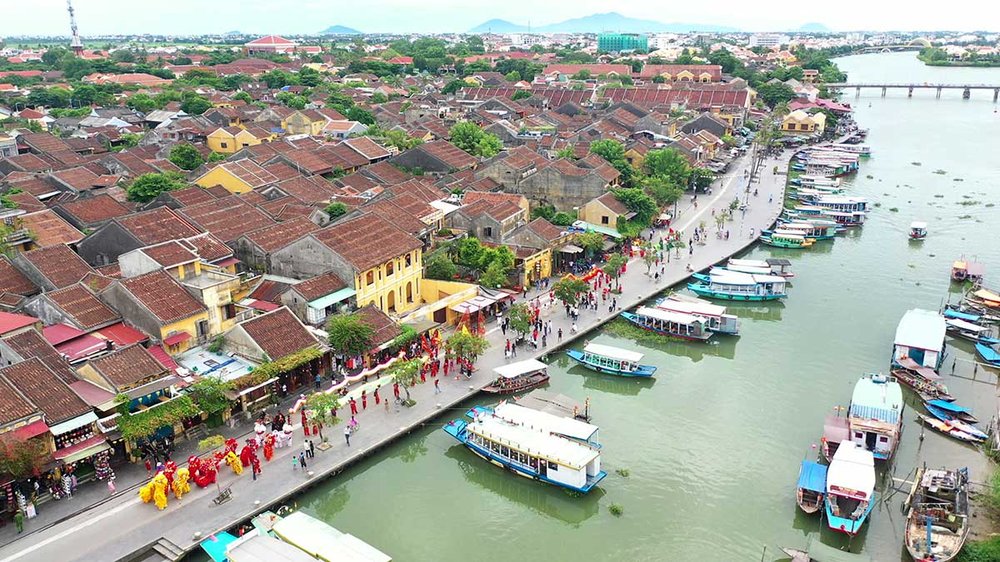 Photograph · Quang Ngọc / Hội An Centre for Cultural Heritage Management and Preservation
On 6 August 2026, the programme the city announced beforehand ran lion, unicorn and dragon dancing through the old town's main streets. Separate press coverage shows international lion and dragon troupes performing at the festival in other years. The busiest day of the year, though, is not the festival itself. Every year, from the fourteenth to the sixteenth day of the first lunar month, thousands travel in from Hội An and the surrounding region for Tết Nguyên Tiêu, the first full moon of the lunar year, to ask for luck. They queue for two or three hours before their turn to burn incense. Almost four centuries after Minh Hương and Vietnamese townspeople built it together, the temple stands where it always stood, and people still come.
- “Miếu Quan Công (Chùa Ông, Trừng Hán cung), số 24 đường Trần Phú, phường Minh An” — hồ sơ di tích, hoianheritage.net
- “Lễ vía Quan Công” — Trung tâm QLBT Di sản Văn hóa Hội An (2012)
- “Lễ vía Quan Công ở Hội An” — chuyên đề nghiên cứu, Nguyễn Đức Minh, hoianheritage.net (2025)
- “Một số thông tin về Hội An, Quảng Nam qua ghi chép của Quốc sử quán triều Nguyễn trong Đại Nam thực lục” — hoianheritage.net
- “Chùa Ông Hội An” — Cổng thông tin Phố cổ Hội An, Di sản văn hóa thế giới
- “Quan Thánh miếu Hội An và bút tích của thân phụ đại thi hào Nguyễn Du” — Trần Tử Quang, báo Dân trí (2012)
- “Về Hội An, dự lễ vía Quan Công” — Khánh Chi, báo Văn Hóa (2026)
- “Đô thị cổ Hội An” — Wikipedia tiếng Việt
- 蔣為文 (Chiung Wi-vun), “越南會安古城當代明鄉人、華人及越南人之互動關係與文化接觸”, 《亞太研究論壇》số 61 (2015), tr. 131–155
- “Lý lịch di tích — Miếu Quan Công (Chùa Ông)” — hồ sơ số 06/ĐK-BQL, Ban Quản lý Di tích Hội An (1991)
- “Ngôi chùa 370 năm thờ ngựa Xích Thố giữa phố cổ Hội An” — Nguyễn Đông, báo VnExpress (2026)
- Quan Công Miếu (Chùa Ông) 01.jpg — Chainwit., CC BY 4.0