
_-_img_02.jpg)
A Buddha Adrift
The story the town tells starts before there was a hall at all. A statue of the Buddha, so the story goes, drifted ashore along this stretch of riverbank, gilded enough that people nearby raised money to fell timber and build a small temple for it. They called it Kim Sơn Tự, the Golden Mountain Temple. The 1992 heritage-registration file that still describes the building repeats the same story, then asks, in its own margin, whether the tale has some root in the Cham people who lived here firstAS THE FILE ASKS ITSELFtruyền thuyết này phải chăng có liên quan đến người Chàm xưa?Lý lịch di tích Chùa Phước Kiến — Ban Quản lý Di tích Hội An, 1992.
Rain and sun wore the little temple down for decades, waiting for someone to take it over.
A Sea Goddess Inland
In 1697, with Hội An's port trade at its height, merchants from Fujian arriving each trading season began settling for good. They bought the abandoned temple by the river and rebuilt it as their assembly hall, a place to meet as countrymen and to pray. Thiên Hậu, the Heavenly Mother, took the altar of the main sanctuary.
The chronicle they still read from records her as Lâm Mặc Nương of Bồ Điền county in Mân, present-day Fujian, born in the year 960 under the Song dynasty. After her death she was said to appear at sea and pull sailors from wrecks. The Song court granted her its first title in 1122. The Qing court's last addition to it came in 1839. The Nguyễn court in Việt Nam issued its own titles twice, in 1826 and again in 1850.
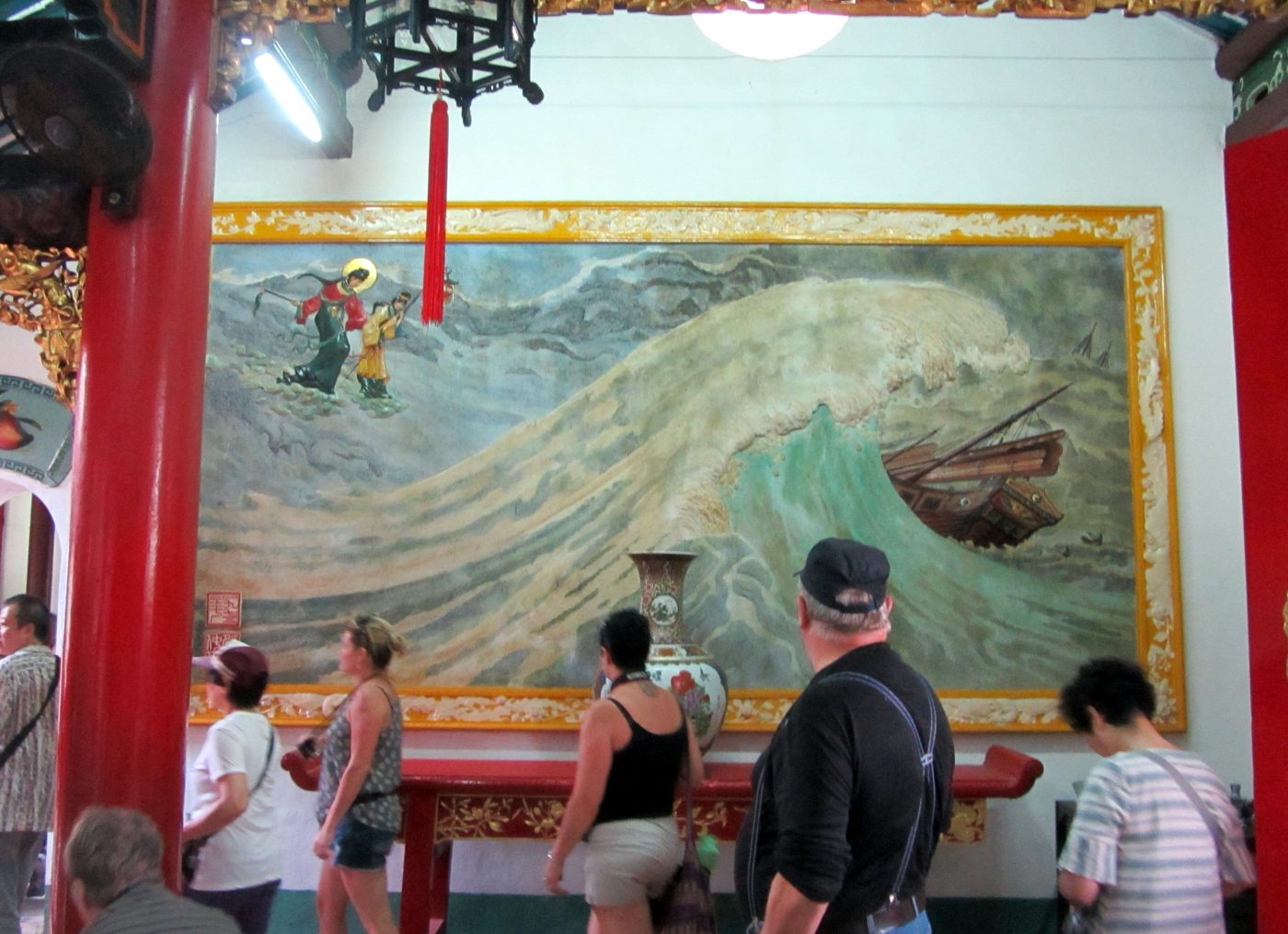 Photograph 2015 · RThiele · Wikimedia Commons · CC BY-SA 4.0
A model junk about two metres long still stands near the altar. The hall's own tradition holds it is the boat Thiên Hậu used to reach the drowning. Its hull, though, follows the exact lines of the merchant junks Chinese traders sailed to get here in the first place.
A goddess of the open sea, given the grandest altar of the community, in a town built inland along a river.
From Thatch to Tile
The hall was still a thatched building by the river. In 1757 the Fujian bang paid to rebuild the whole structure in tile and renamed it the hall of the Mân Thương merchants. Two renovation steles still standing inside the hall today record that year under the Qing reign name, Qianlong dingchou.
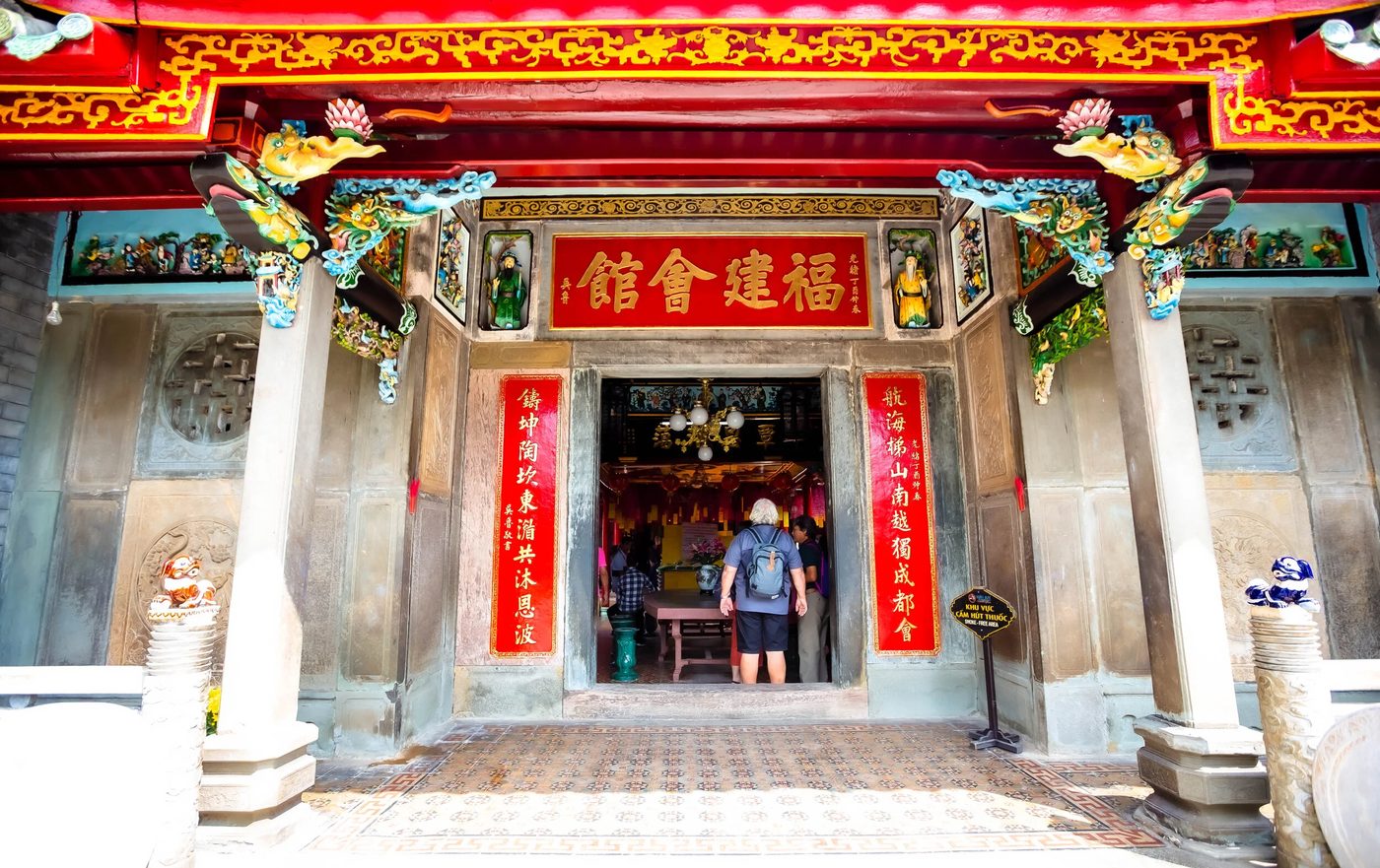 Photograph 2020 · Josh Ellis · goteamjosh.com
A roof beam in the rear hall carries the names of who built it: the bang's leader, its manager, its temple steward, its ship captains and its merchants, named together. The beam is dated by the reign name Long Phi, a name Ming loyalists overseas kept using long after their dynasty had fallen, rather than by any reign name of the Qing court that had just conquered their homeland. The Ming was gone. The name stayed.
Carved onto a beam that helped fund a hall built under Qing rule, that reign name reads as an act of memory as much as a date.
The Minh Hương community, descendants of earlier Ming refugees who had taken Vietnamese nationality generations before, kept a different name for the place. A votive plaque they donated in 1851 still calls it by its old name, the Kim Sơn shrineTHE 1851 PLAQUE金山廟重修誌慶 明鄉信善族仝奉供Vietnamese reading: Kim Sơn miếu trùng tu chí khánh — Minh Hương tín thiện tộc đồng phụng cung.蔣為文 (Chiung Wi-vun), 2015, tr. 144 — biển thờ năm Tự Đức 4 (1851) còn trong hội quán, nearly a century after the official rename.
The Chợ Dinh Stele
A stele inside the hall records the repair of the Dinh market, dated to the sixth year of Gia Long, 1807. It names the men behind the work: bang leader Hứa Tân Phát, manager Hầu Hòa Lợi and graduate Nguyễn Cố Thịnh, with 51 signatures beneath them.
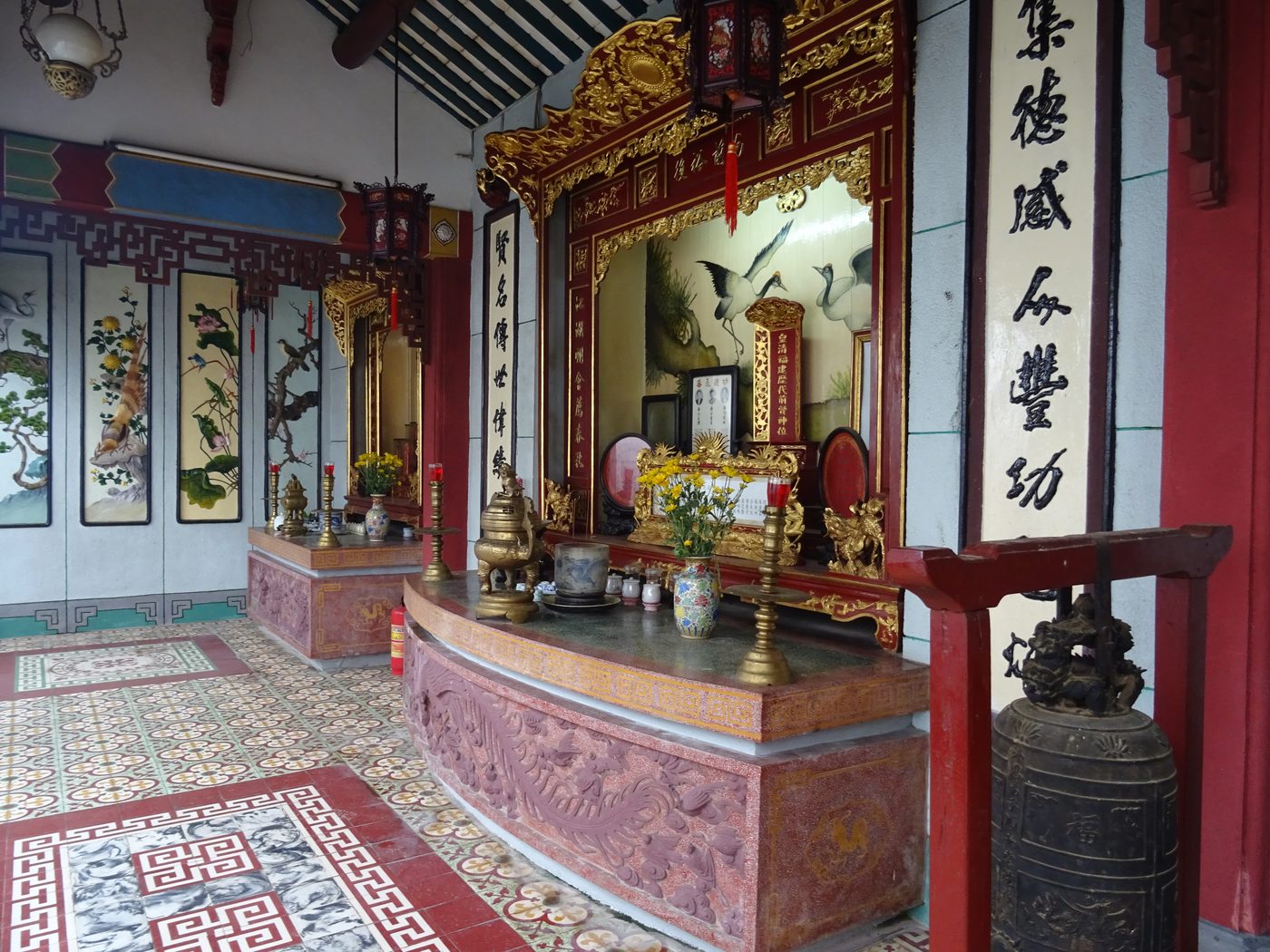 Photograph 2018 · Christophe95 · Wikimedia Commons · CC BY-SA 4.0
The historian Chen Ching-Ho read this stele as the earliest firm evidence that Hội An's Chinese community already had an elected bang leader, years before the office was first named in the Nguyễn court's own chronicle.
A market repair, and it turns out to be the birth certificate of an entire system for governing a foreign community.
Six Who Would Not Yield
In 1849 the hall added a rear sanctuary, the only one of its kind among Hội An's five Chinese halls. It holds the Lục Tánh Vương Gia, six lords honoured as guardians of the Fujian community.
The story the town tells goes back to the fall of the Ming. Six generals refused to submit when the Qing army conquered China in the seventeenth century, rose against it, and died in the fighting. People from Mân, their home province, carved statues and gave each one a name: Lord Khâm, Lord Trương, Lord Thuấn, Lord Chu, Lord Hoàng and Lord Thập Tam. A field survey carried out inside the hall and a study built from its own inscribed steles, done independently of each other, arrive at the same six names.
The Lục Tánh festival falls every year on the sixteenth day of the second lunar month, the largest of the hall's year, drawing visitors from Đà Nẵng, Tam Kỳ, Huế and Quảng Ngãi. Here, six men who lost their war at home draw the year's biggest crowd of worshippers.
Eighty-Six Columns
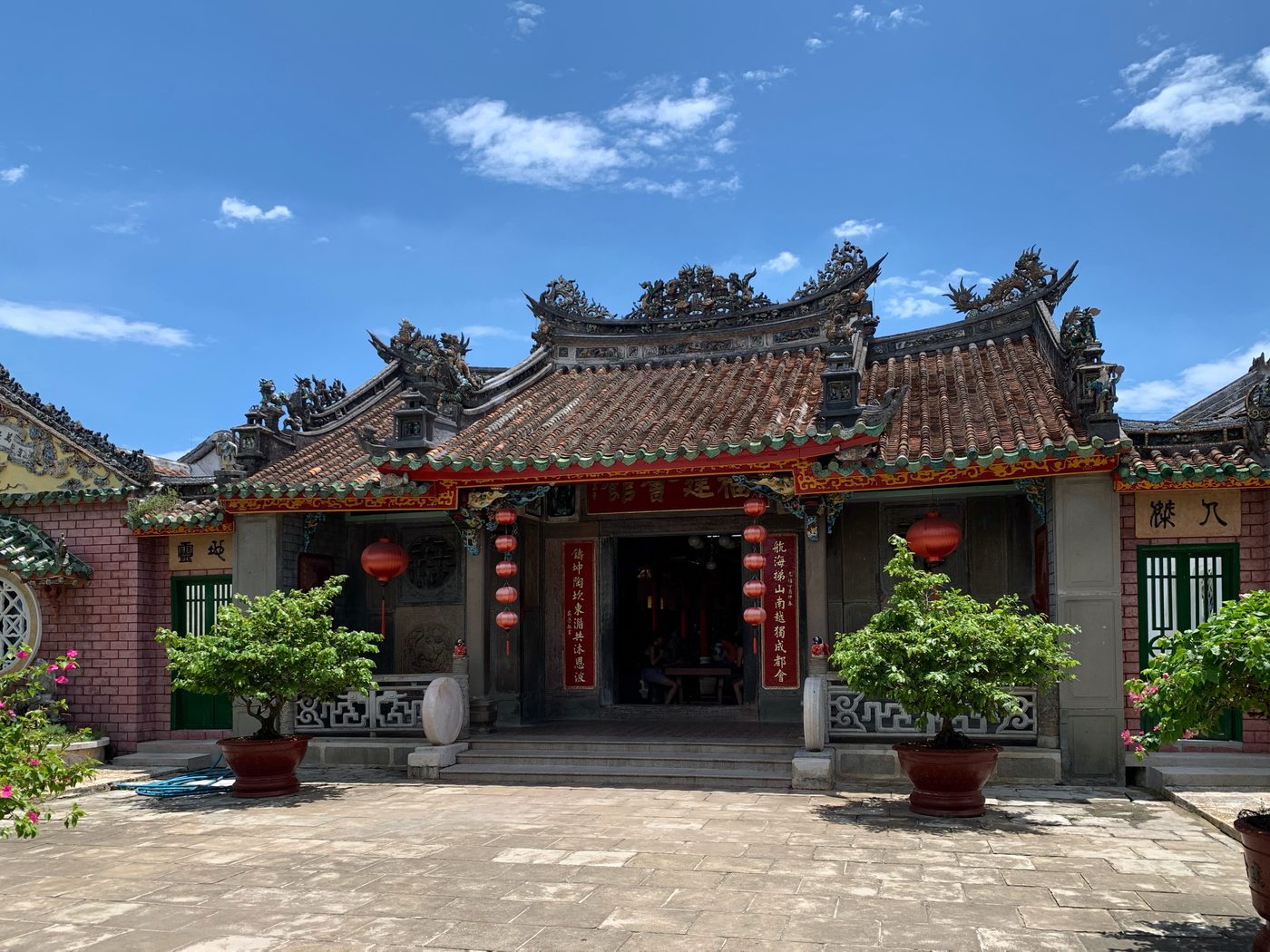
Between 1895 and 1900 the hall grew to the footprint it still holds: 120 metres deep, 24 metres wide, 2,000 square metres in all, the largest of Hội An's five Chinese halls.
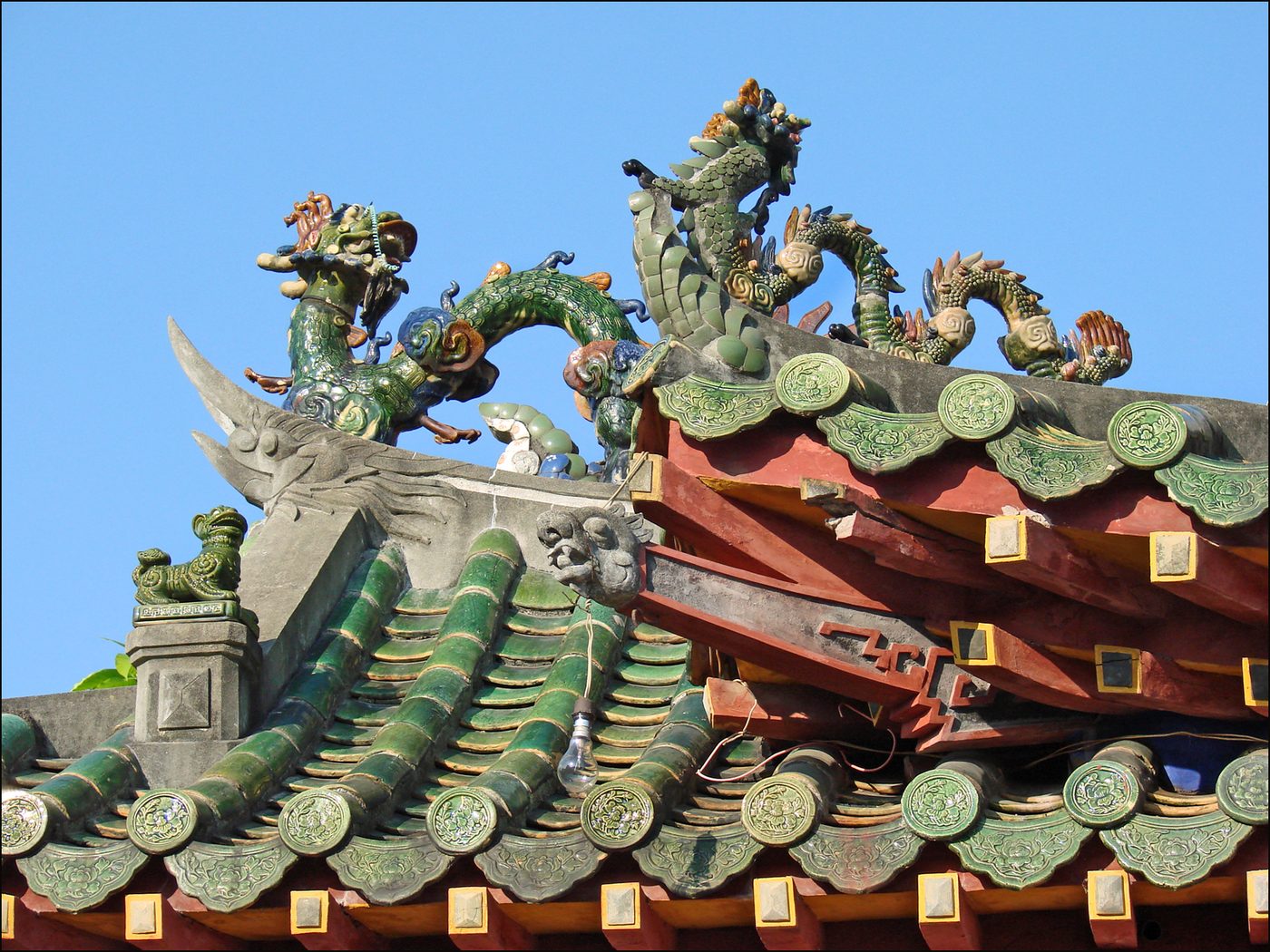 Photograph 2010 · Jean-Pierre Dalbéra · Wikimedia Commons · CC BY 2.0
It also carries the most columns of any of the five, 86 in total, ahead of the Trung Hoa hall's 66 and well past the Quảng Triệu hall's 24, the fewest. The roof over its front hall is the most elaborately carved of the five. Yin-yang and fish-scale tile roof its open courtyard and main sanctuary, a covering none of the other halls in town use. The rest of the quarter's roofs use plain barrel tile.
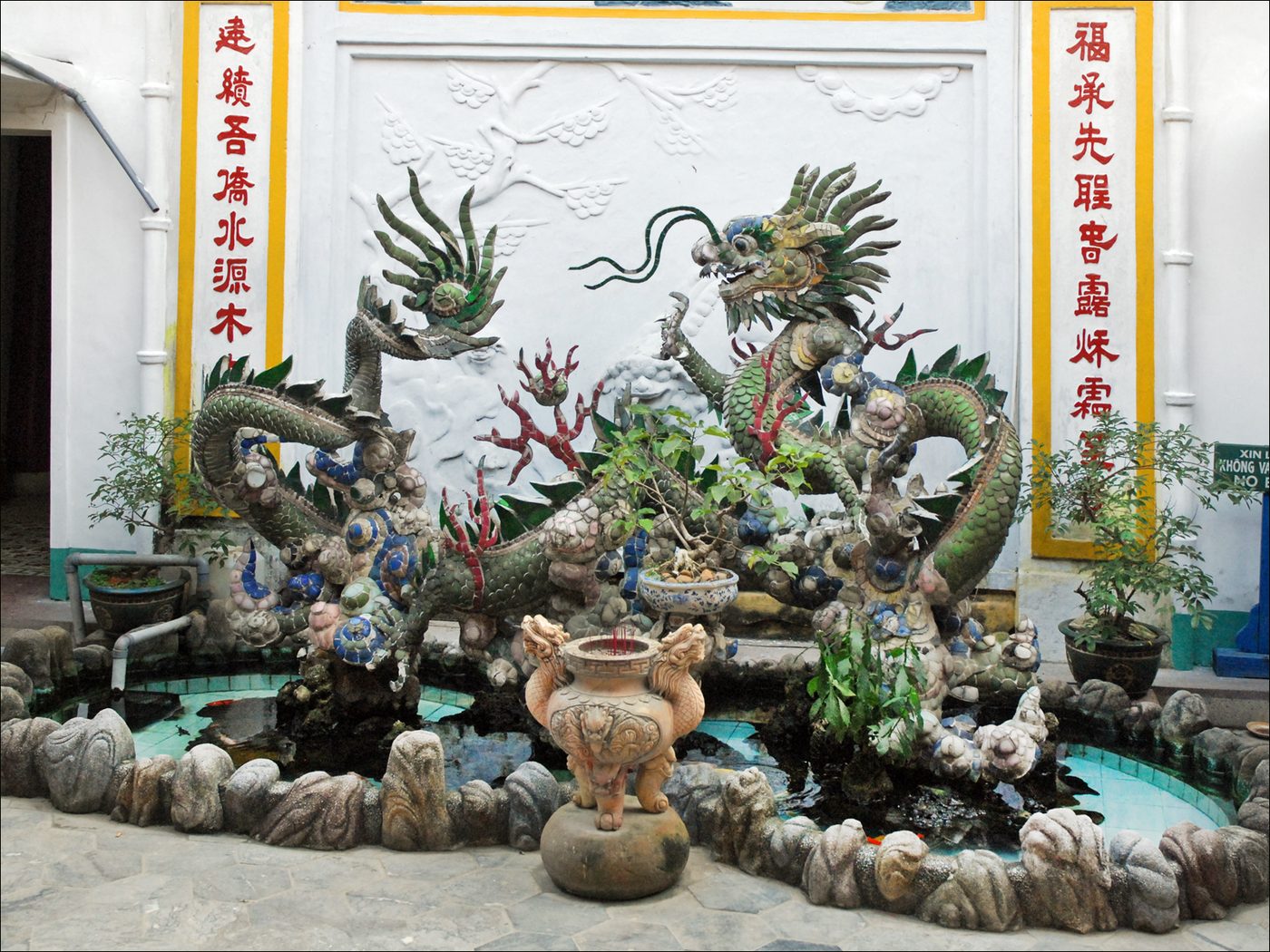 Photograph 2010 · Jean-Pierre Dalbéra · Wikimedia Commons · CC BY 2.0
The hall's foundation also sits higher than the other four. When Hội An's floods rise through the old quarter each rainy season, they rarely reach the altar here.
A New Gate to the Street
The largest restoration ran from 1970 to 1974. Workers rebuilt the triple gate entirely, added a new reinforced-concrete gateway flush with Trần Phú street, repaved the courtyard, and built a plum-blossom-shaped pond with five carp spouting water at the front.
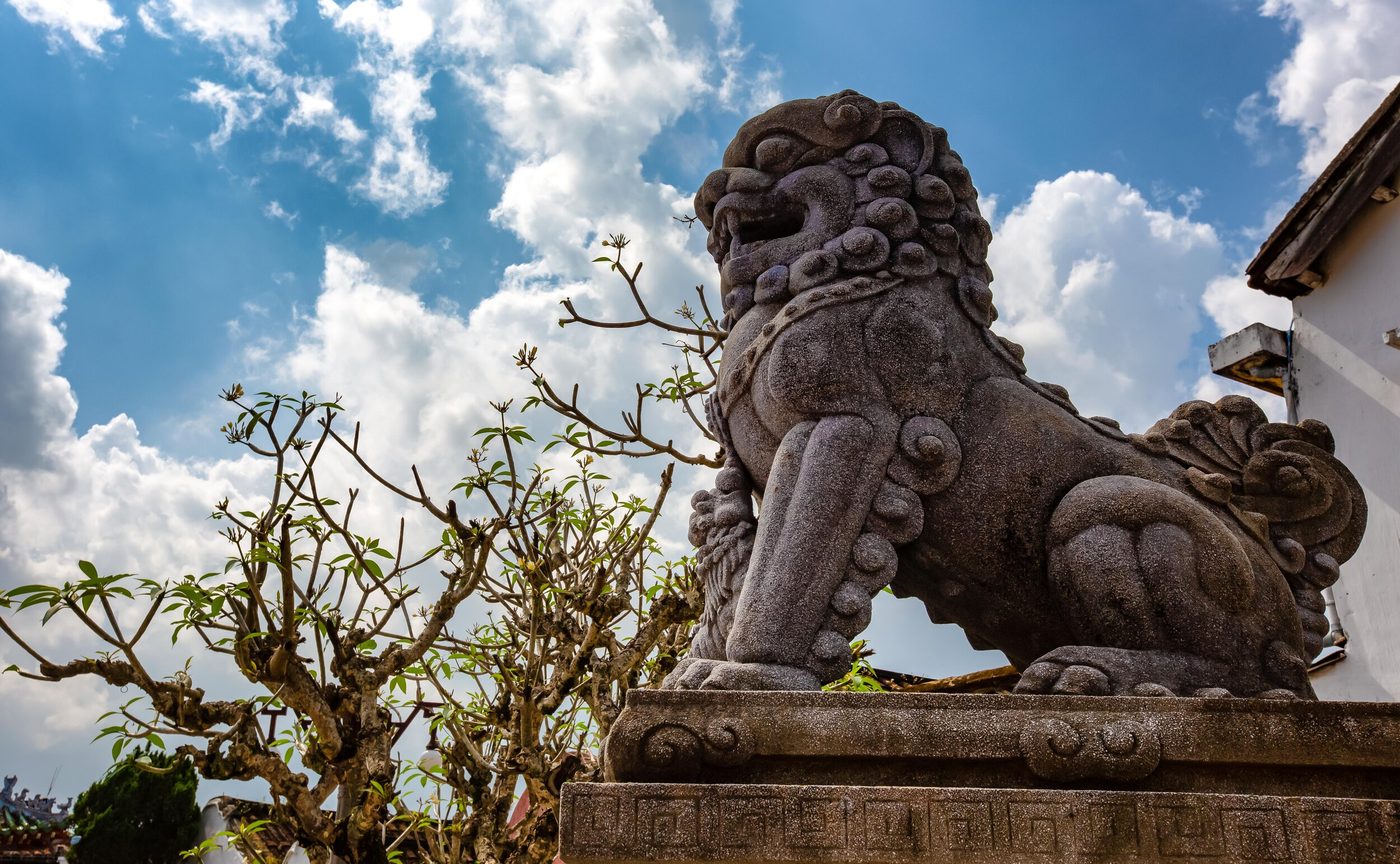 Photograph 2020 · Josh Ellis · goteamjosh.com
Above the new gate, seven short tiled roof tiers stack toward a small crowning gate of their own, flanked by figures of the sun god and the moon god. Between them sit four stone characters, Kim Sơn Tự, the temple's very first name, kept at the top of a gate built more than two centuries after the hall itself stopped using it.
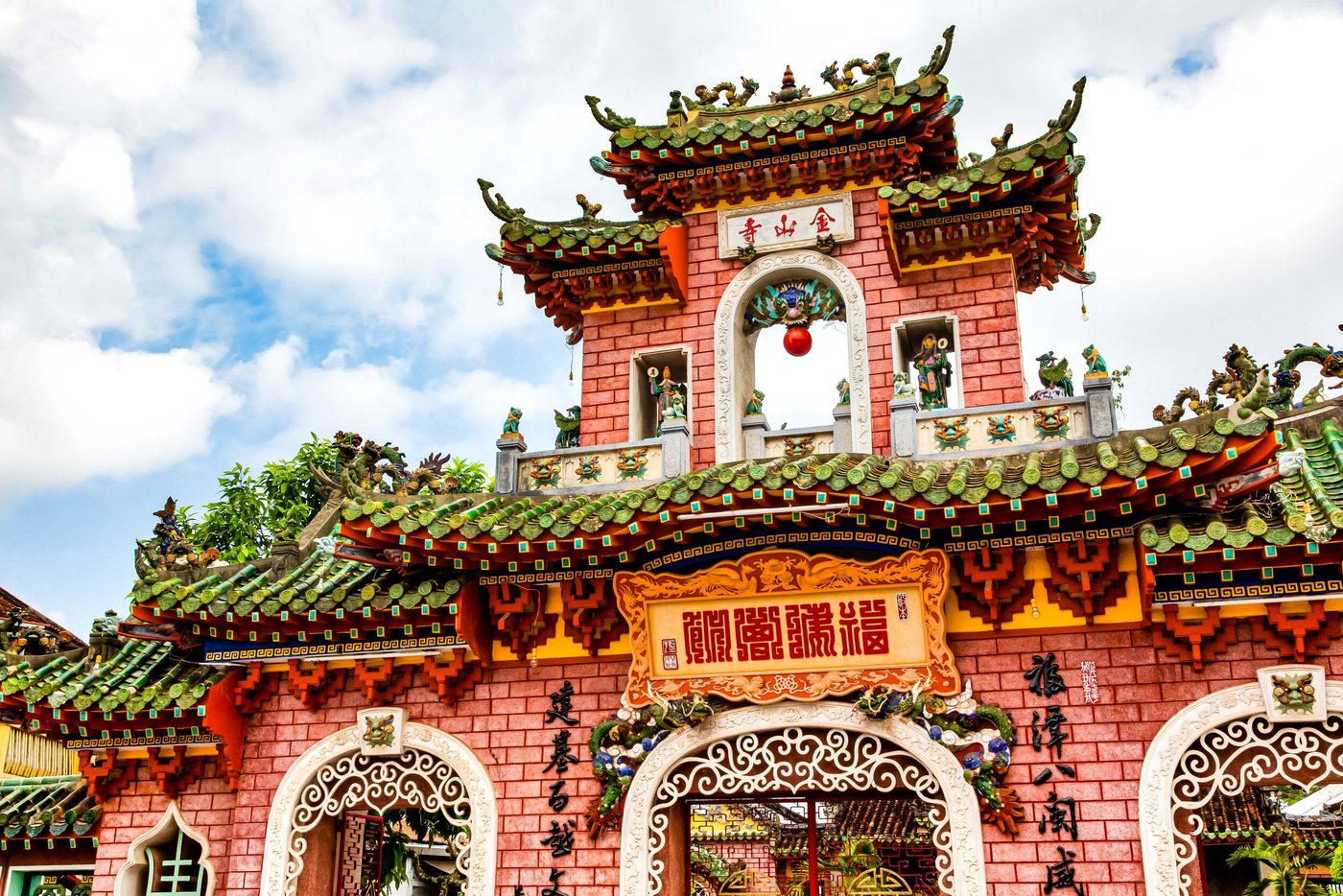 Photograph 2020 · Josh Ellis · goteamjosh.com
A beam inside the rear hall carries a date in the Western calendar for once: 1975, the year the Fujian community together renovated the hall, a year after the restoration project's recorded end date. It most likely marks when the community dedicated the beam itself, not the whole span of the work.
Three Hundred Years On
The hall was listed as a national historical and cultural relic in November 1989. It had already been drawing tens of thousands of visitors and researchers a year since 1983.
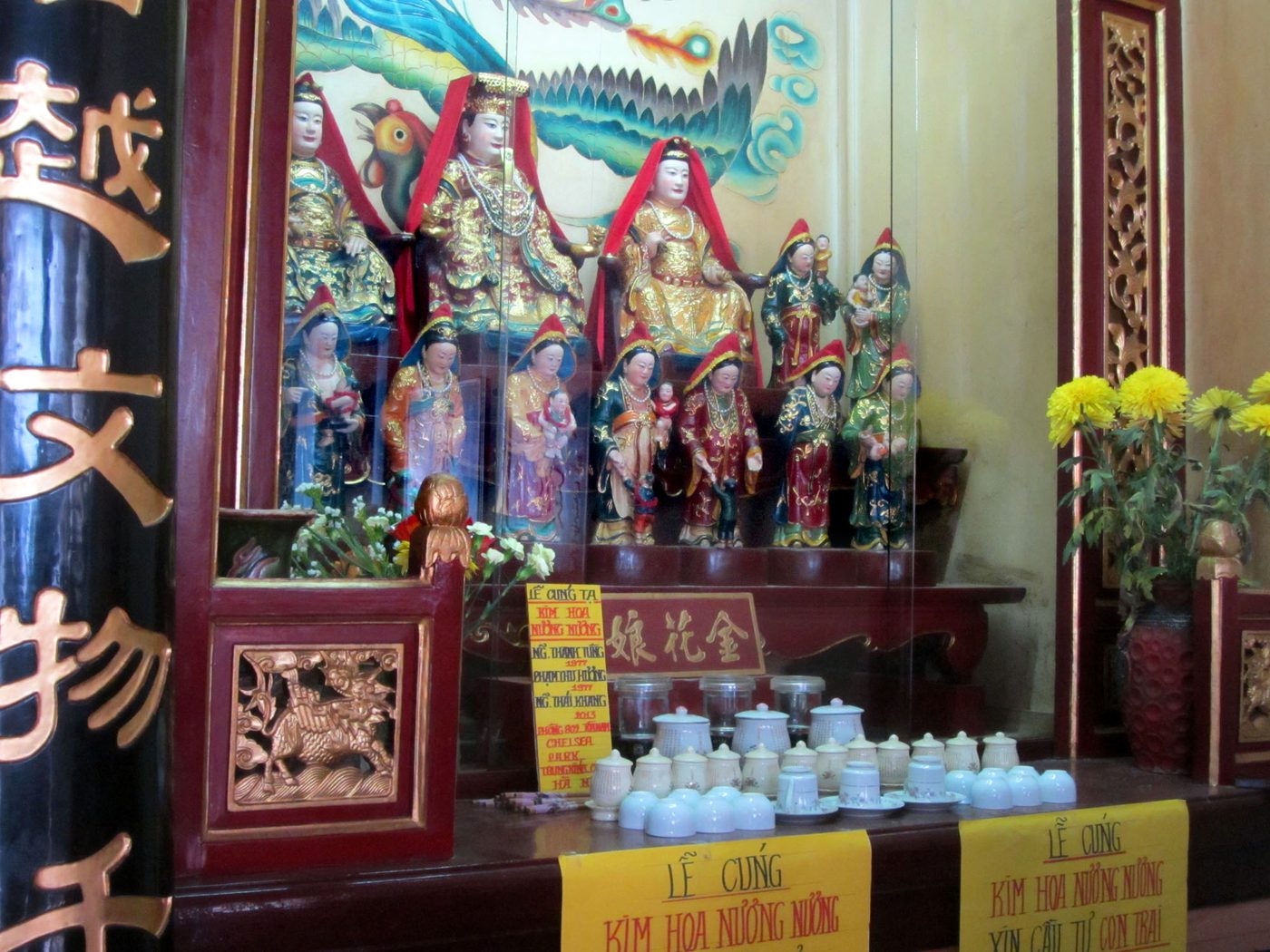 Photograph 2015 · RThiele · Wikimedia Commons · CC BY-SA 4.0
The rear hall keeps one more shrine, to Kim Hoa Nương Nương and her attendants, the three Bà Chúa Sanh Thai and the twelve Bà Mụ, deities who oversee pregnancy and birth. People with no tie to the Fujian bang still come here. Vietnamese residents of the quarter among them light incense asking for a child, or turn to the wealth god Tài Bạch Tinh Quân's altar next to it asking for good trade.
Descendants of the bang have scattered since, some of them overseas, and still send money home for the hall's small repairs. Three hundred years after a statue supposedly drifted ashore on this stretch of river, the hall built over it still stands. Someone still calls it home.
- Lý lịch di tích — Chùa Phước Kiến (Phước Kiến Hội quán — Kim Sơn Tự), số 53/ĐK-BQL, Ban Quản lý Di tích Hội An, 1992
- “Hội quán Phúc Kiến - Số 46 đường Trần Phú - Phường Minh An” — hoianheritage.net
- “Lễ vía Lục tánh ở Hội quán Phước Kiến” — hoianheritage.net
- “Lễ vía Thiên Hậu Thánh Mẫu” — hoianheritage.net
- “Kiến trúc cổ các hội quán của người Hoa ở Hội An (Quảng Nam)” — Trung tâm QLBT Di sản Văn hóa Hội An
- 蔣為文 (Chiung Wi-vun), “越南會安古城當代明鄉人、華人及越南人之互動關係與文化接觸” — 《亞太研究論壇》số 61 (2015), tr. 131–155, Viện Nghiên cứu Trung ương Đài Bắc
- “Về tổ chức bang, Minh Hương xã và Thanh Hà phố của người Hoa ở Việt Nam” — Khoa Văn học và Ngôn ngữ, ĐHKHXH&NV TP.HCM
- Mục “Hội quán” — Trung tâm QLBT Di sản Văn hóa Hội An
- Hội An 2024 - Fujian Assembly Hall (Hội quán Phúc Kiến , 會安福建會館) - img 02.jpg — Chainwit., CC BY 4.0