

The Lantern Arrived With the Trader
Local scholarship has not settled on one year. A study published in a Vietnamese culture journal dates the lantern's appearance at Hội An to the late 16th century, just as the first Chinese-born traders arrived to settle. Hội An's own heritage-conservation centre places the craft in the 17th century instead. The two accounts differ by a few decades, but they agree on the same shape of the story: the lantern came in with the trader, it did not grow up on its own.
At the port town, lanterns were soon a fixture at weddings and funerals, especially in the households of foreign-born residents. Local demand pulled the craft in with it, and from the start it drew on techniques passed between Vietnamese, Chinese, Japanese and Western makers.
Documents from the 18th century describe the practice more precisely. On the lunar new year, on the first full moon of the year, at birthday celebrations for the Nguyễn lords, and whenever officials arrived from the regional seat in Quảng Nam to make their rounds, the three villages of Hội An, Minh Hương and Cẩm Phô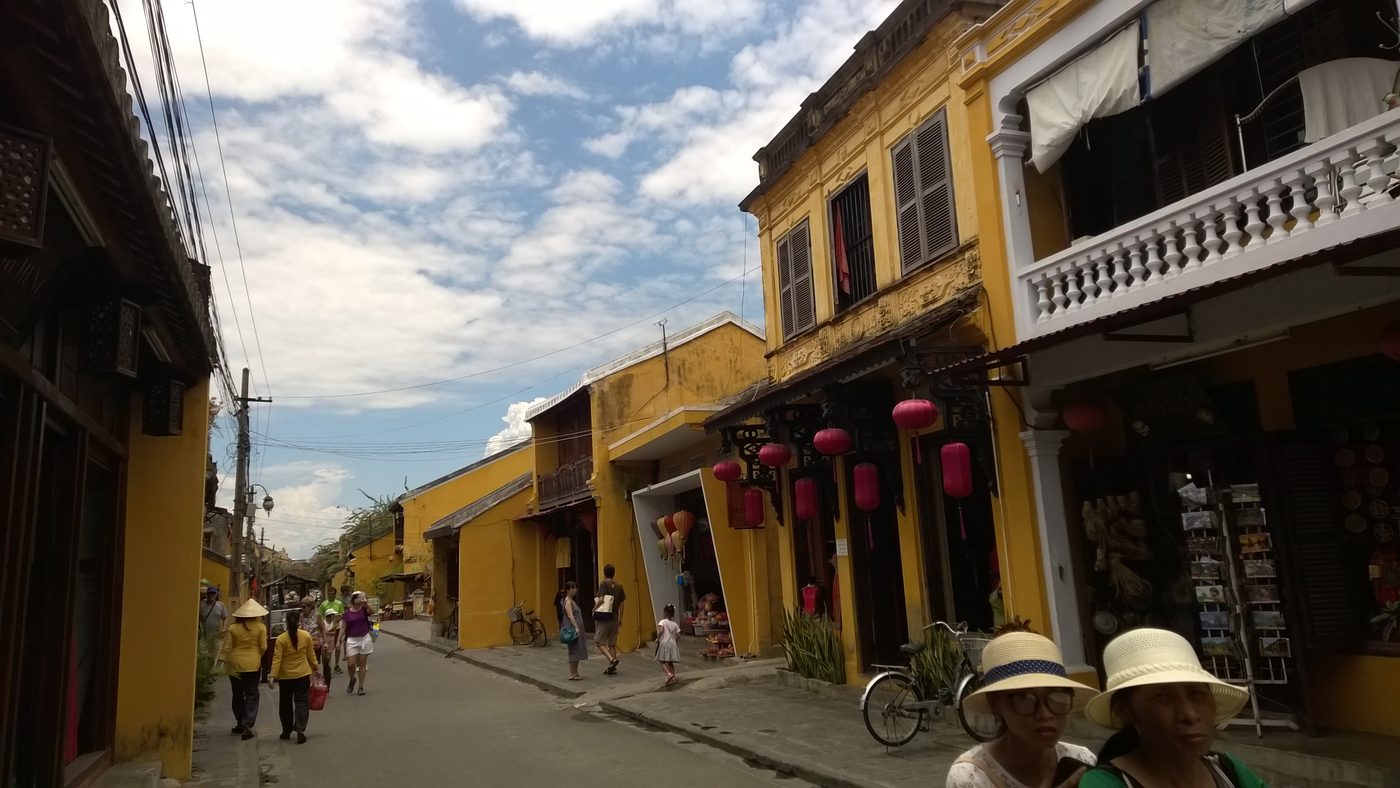 PLACE · QUARTERThe Chinese QuarterSixteenth century · to nowChinese merchants reached Hội An on the monsoon and meant to leave on the monsoon, which is why the town called them người Tàu, the people who came by boat. Then some of them stayed, and the state had to invent a status to put them in. strung up lanterns and flowers together, lighting the street for the night.
One line in the record is more exact than the rest. The 1787 expense ledger of Lý Tam Bửu Vụ in Minh Hương village notes a payment made that year: a fee for hiring someone to make lanterns for the Trừng Hán shrine, the hall inside the Quan Công temple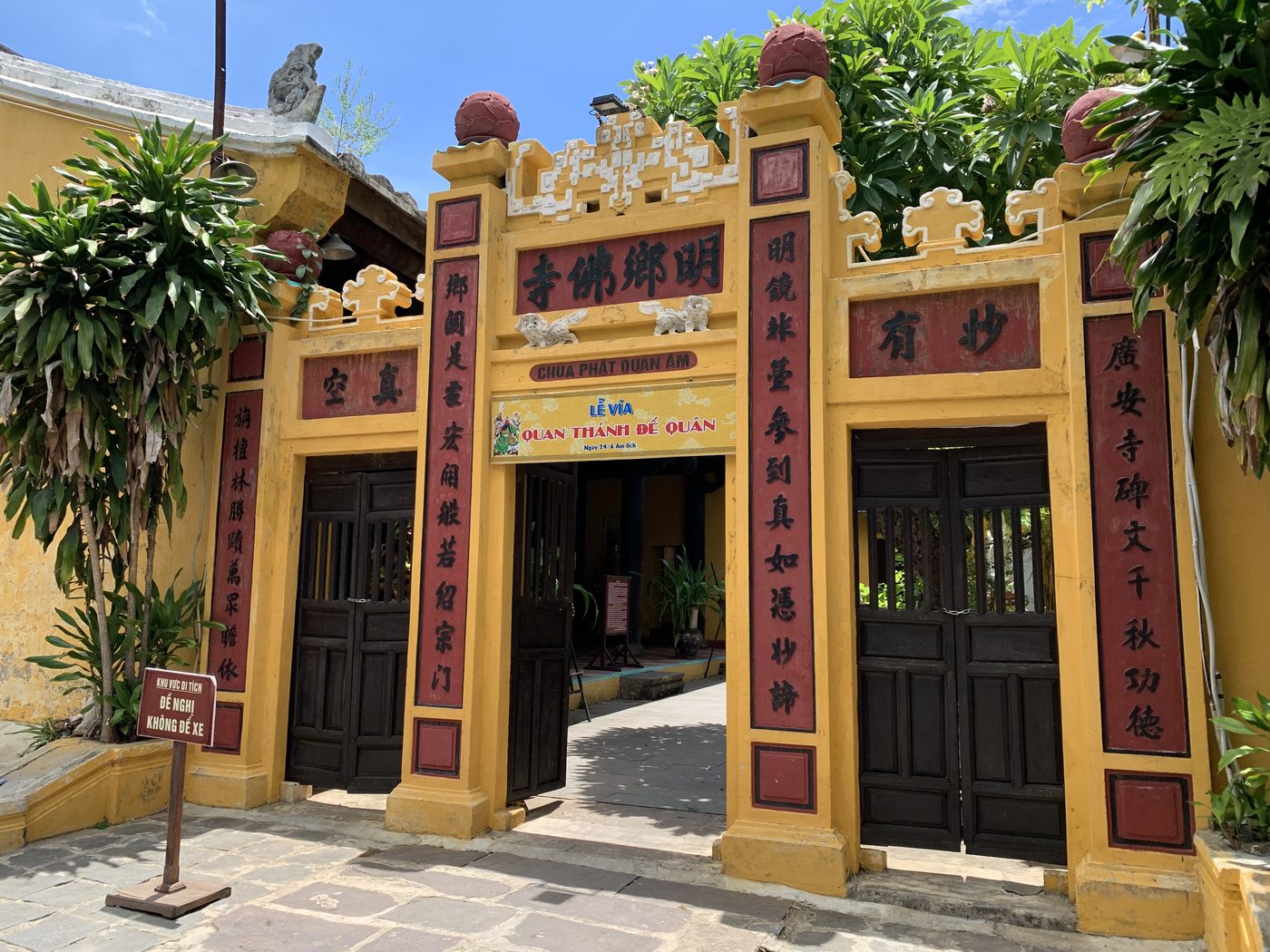 PLACE · TEMPLEThe Quan Công TempleBuilt before 1653Before 1653, the Minh Hương community and the Vietnamese of Hội An built a temple together facing the town market, to worship a defeated Chinese general who had become the guarantor of good faith for the whole trading street.. This is not a recollection but a line of accounts, proof that Minh Hương village was already paying for lantern-making as a costed service.
Long before it became a souvenir, the lantern already had a job: to light a procession, to see off a funeral, to mark the day an official passed through town.
Bamboo and Paper, Timber and Script
Vietnamese makers kept to a familiar method: a bamboo frame, paper glued over it, shaped into the bánh ú cake, the star or the carp still carried at the Mid-Autumn festival. Chinese and Minh Hương makers went a different way. They built the frame from timber, added the revolving kéo quân lantern, and painted the panels with auspicious Chinese characters or the name of a clan, a trading house or a meeting hall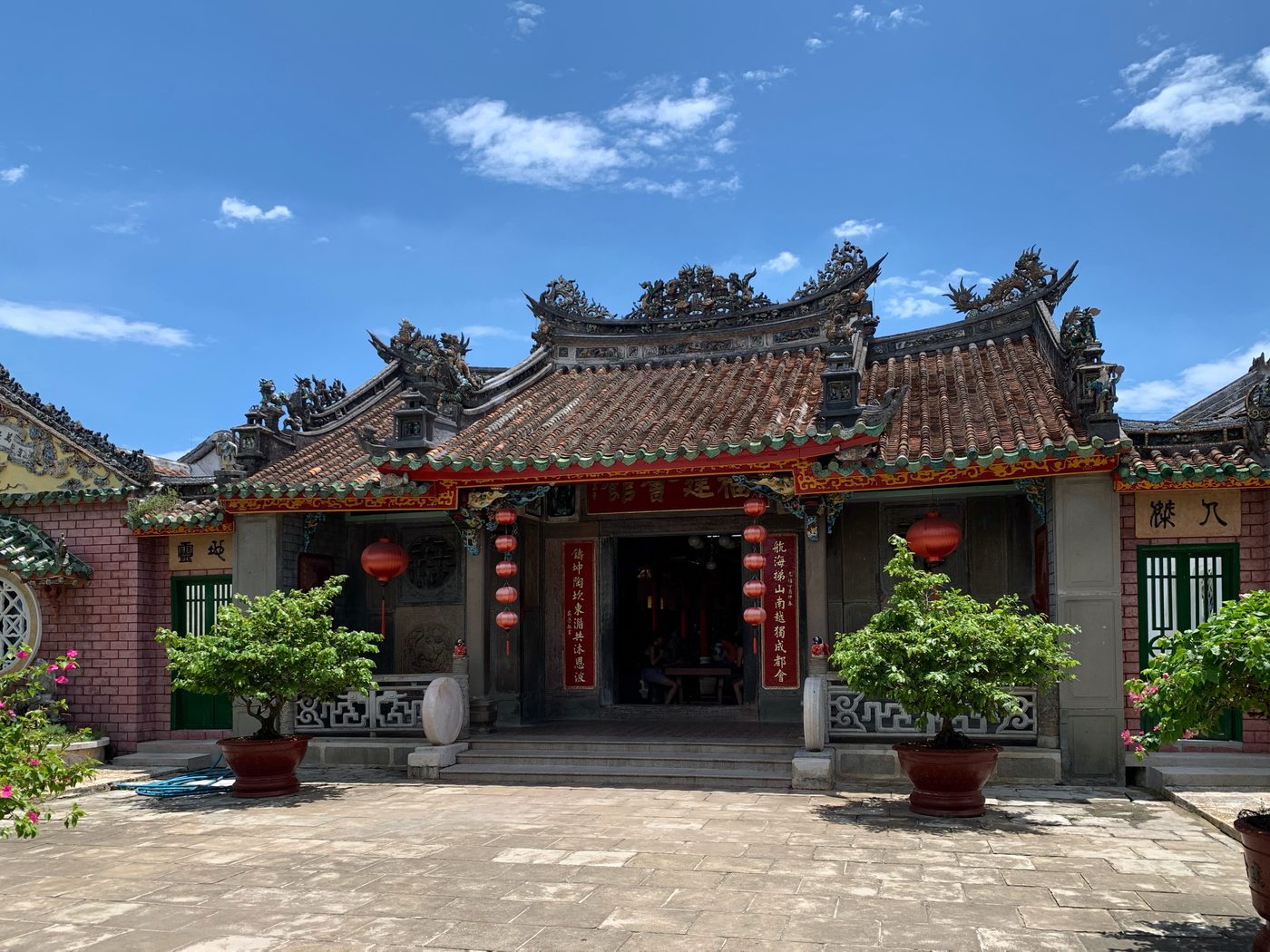 PLACE · ASSEMBLY HALLThe Fujian Assembly HallFounded 1697 · rebuilt 1757–1900A small riverside temple from 1697 grew, renovation after renovation, into the largest of Hội An's five Chinese assembly halls..
photograph · Wikimedia Commons · CC BY 4.0The French came later still, and left behind lanterns of porcelain, of aluminium, with panels of coloured glass. Trần Văn An, deputy director of Hội An's heritage-conservation centre, put it plainly: experience and technique from many different styles had gathered at Hội An, and that gathering was what let the craft grow.
Looked at closely, a Hội An lantern is four countries' way of making light, standing inside one frame.
Ten Days in Salt Water
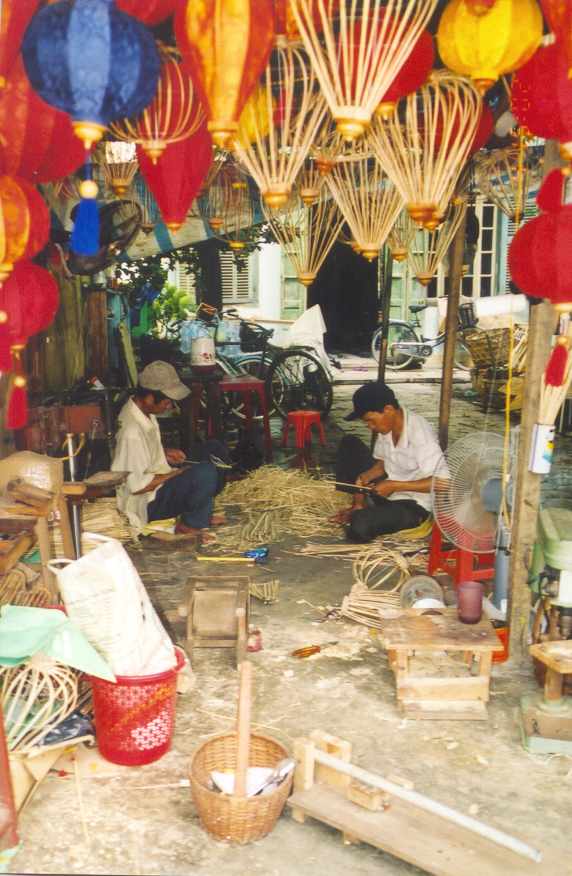
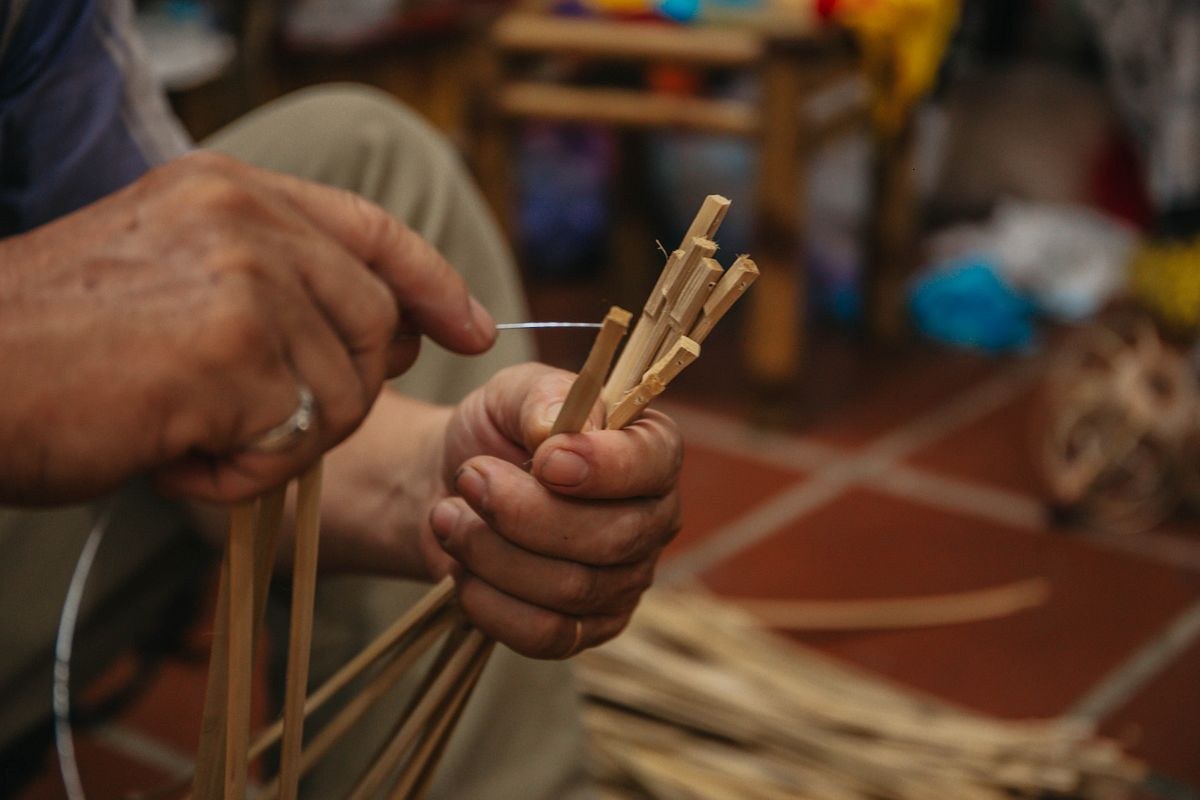
The bamboo for a lantern must be old but not yet dry. Workers boil it, then soak it for ten days in salt water to keep off termites, dry it fully, and only then split it into thin strips, thicker or thinner depending on the size of the lantern.
 photograph · Xuân Phương / Saigoneer, 2024
The cover is xoa cloth or raw silk, chosen for a weave tough enough not to tear when stretched. The work runs in two stages. First the frame: a worker sets bamboo strips into two wooden rings, one at each end, and ties them down with nylon cord until the shape sits true. Then the cloth: cut to size beforehand, glued on, trimmed at the edges. The cord for hanging the lantern is nothing more than a synthetic thread tied to a small wooden bead. It is a small part. Without it there is nothing to hang the lantern from.
From splitting the first strip to gluing on the last panel takes four full days, three of which go to painting and decoration — the part of the work that decides what the lantern looks like once it is lit.
Garlic, Round, Diamond, Parasol
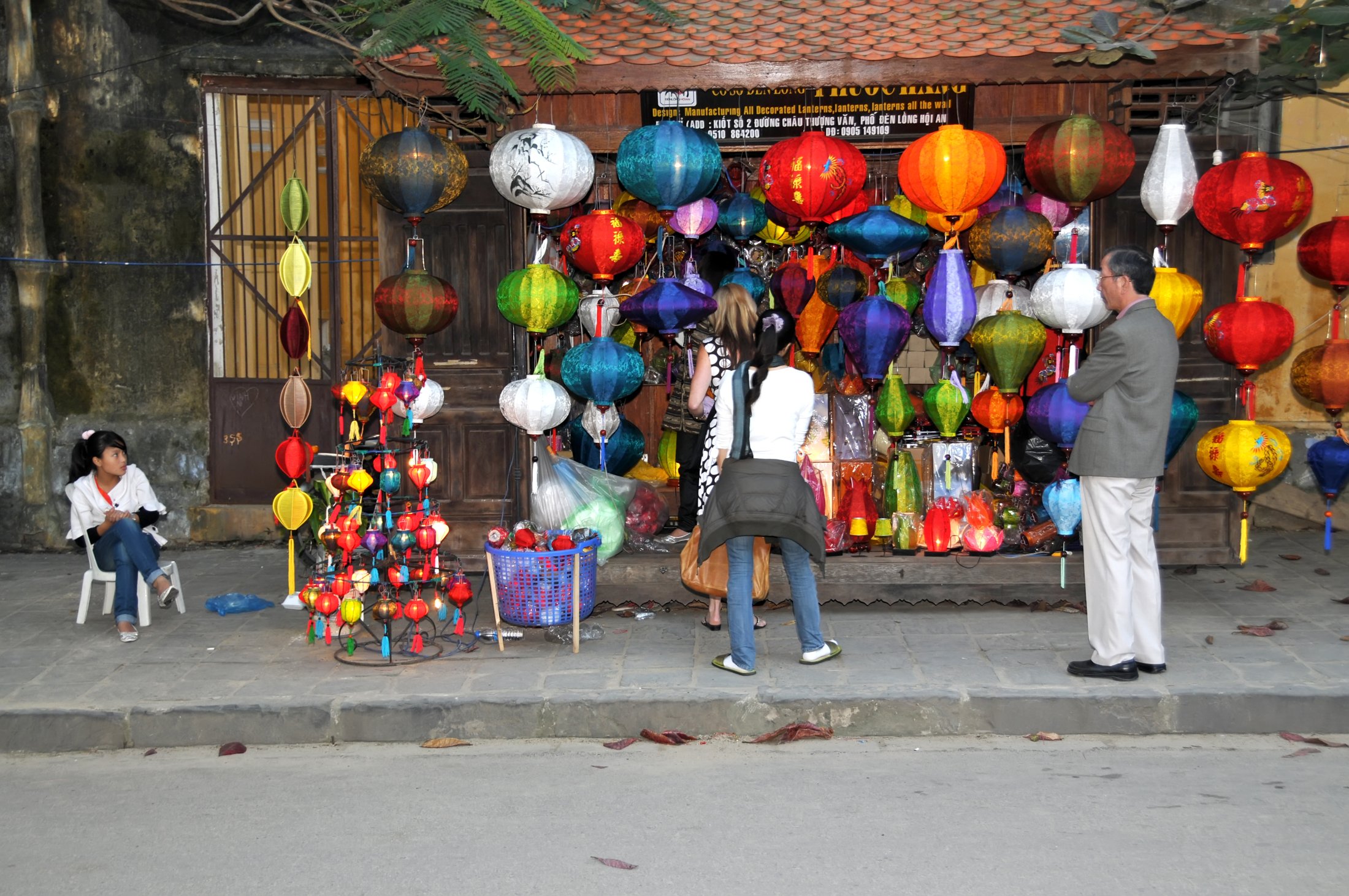
Not every shape counts as a Hội An lantern. Quảng Nam's standards and measurement bureau has certified nine shapes: garlic, round, diamond, parasol, barrel, olive, papaya, pumpkin and bánh ú cake, all built to the same overall size of 25 by 120 centimetres. Outside those nine, makers still build the revolving kéo quân lantern, the lotus and the dragon, but those fall outside the certified standard.
The hinge, where the frame opens and folds shut, is steel wire between 0.3 and 3 millimetres thick, and the wood for the handle has to resist cracking and swelling as the weather turns hot or cold. Workers treat every material against termites and mould, then coat it for protection, before it goes into the finished lantern.
To carry the name "Hội An lantern", a piece has to match the shape, the material and the size on file. Bamboo and cloth stitched together is not, on its own, enough.
Learning From a Folding Fan
No one knows for certain who founded the lantern craft at Hội An. A number of tourism sites name a man called Xã Đường, said to have made lion-dance heads and festival lanterns. But Hội An's own World Heritage conservation centre, in its own article on the craft, states plainly that nobody knows who the founder was.
Huỳnh Văn Ba came from Thăng Bình and settled in Cẩm Nam, where he worked weaving rattan and bamboo. In the early 1990s he tried making a few old-style round lanterns with fixed frames to sell to visitors. Visitors liked them but complained they were hard to pack for the trip home. One day an Australian tourist wanted one of his lanterns but it would not fit in the suitcase. That single refusal sent him looking for a way to fold the frame flat.
Others came before him. Oral tradition recorded by Hội An's own heritage-conservation centre names a man called Chánh Diệm, who used to re-cover broken lanterns, and after 1975 a Vương Thiệu Quang on Trần Phú street, who was already making round lanterns that could be folded shut. Both stand ahead of Huỳnh Văn Ba in the chain of people who kept the craft going, though neither is named as the one who started it.
 photograph · Xuân Phương / Saigoneer, 2024
He studied how a folding fan and an umbrella opened and closed, then applied the same principle to build a lantern frame that could fold shut.
In December 2010 the President of Vietnam gave him the title of Meritorious Artisan. That small hinge is the reason a Hội An lantern can now be boxed flat and shipped almost anywhere.
One Night a Month Without Electric Light
The craft went through a lean stretch. The idea that called it back did not come from a resident of Hội An. It came from the Polish architect Kazimierz Kwiatkowski, who spent years restoring both Mỹ Sơn and the covered bridge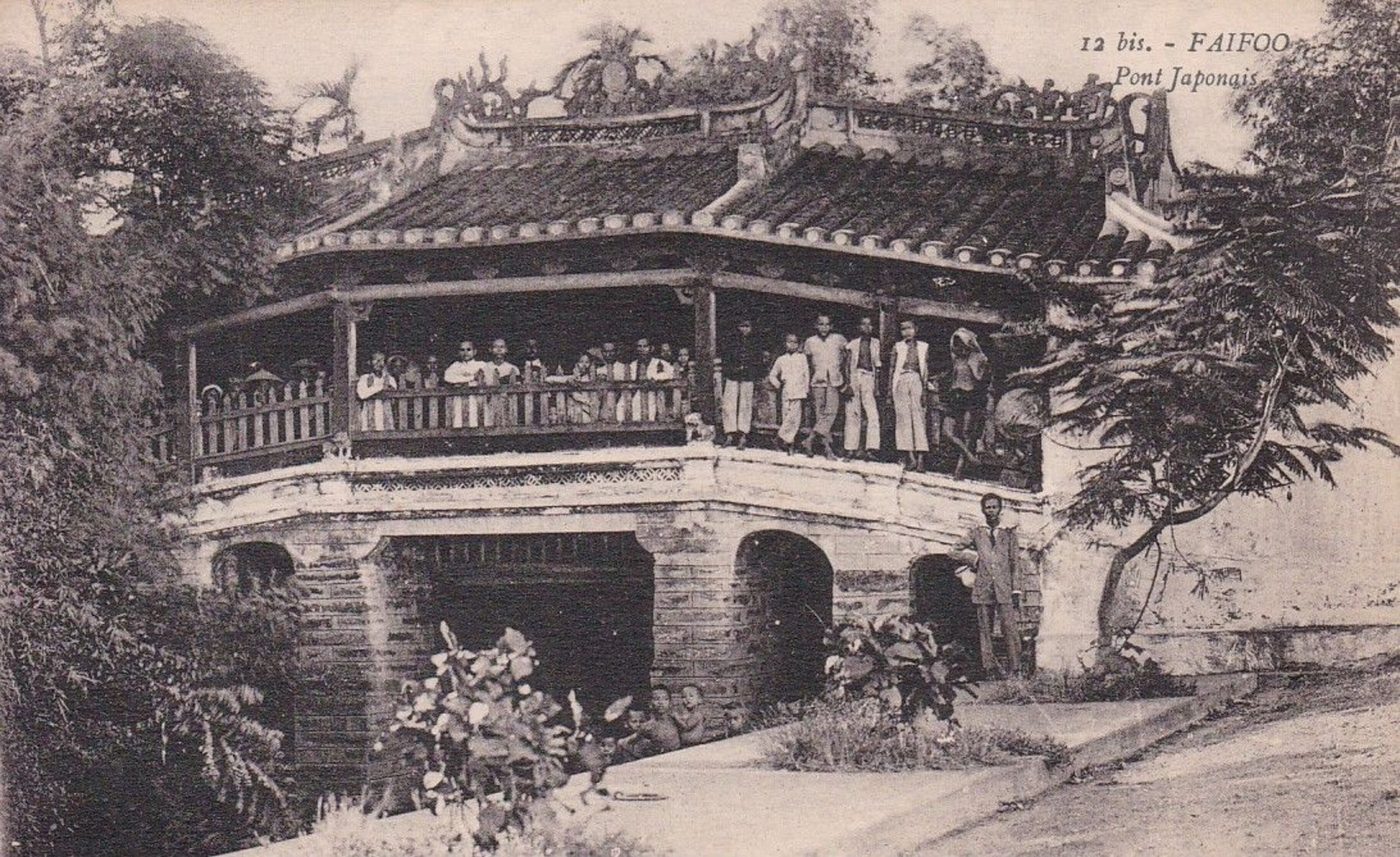 PLACE · ANCIENT TOWNThe Japanese Covered BridgeJapanese merchants paid for it, Vietnamese carpenters built it, a Chinese village kept it, and a Nguyễn lord gave it a name. After eight dismantlings, the part of the four-hundred-year-old bridge that is close to intact is the foundation., and who wanted one night a month that would bring back the feel of the early 20th century.
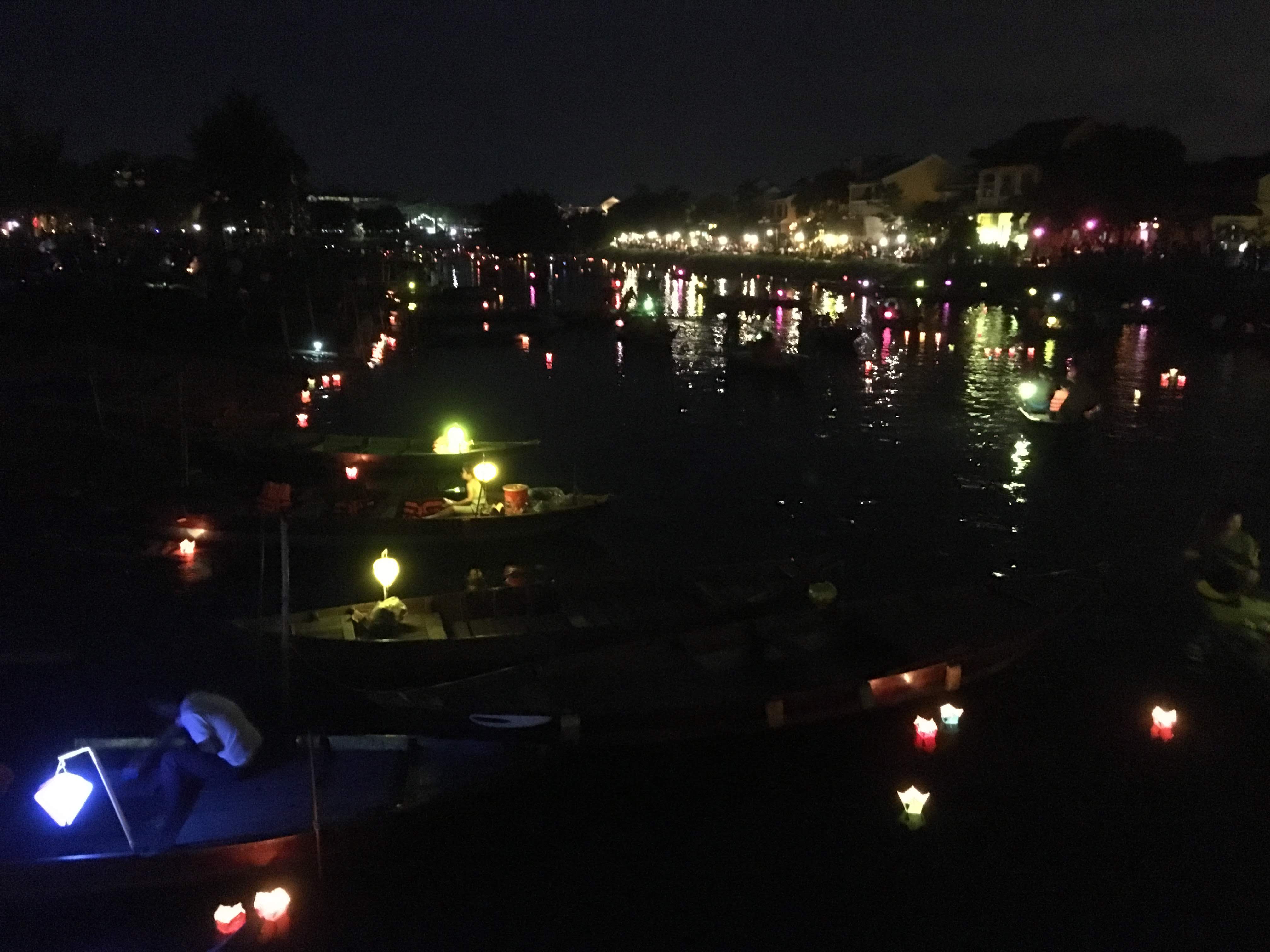
On 8 September 1998, Hội An's city government ran a first trial of an "Old Town Day," after rounds of consultation with local departments and residents. Directive 03/1999/CTUB followed on 23 February 1999. It set the rule that stands today: once a month, on the fourteenth day of the lunar calendar, the old quarter turns off its electric lights, and residents and temples hang out lanterns instead.
 photograph · Christophe95 / Wikimedia Commons · CC BY-SA 4.0, 2018
From then on, anyone who wanted to see Hội An lit for real had to buy a real lantern. The craft had work again.
First Among Seven Festivals
On 18 December 2008, Vietnam's National Office of Intellectual Property registered a collective trademark for the Hội An lantern, with 34 production workshops named on the certificate. Three years later, in 2011, the Vietnam Handicraft Villages Association named it one of nine outstanding traditional craft villages nationwide.
In 2015 the British travel magazine Wanderlust published a list of Vietnam's seven most striking festivals. The "Hội An Lantern Festival" topped it, ahead of the Chử Đồng Tử festival, the Thầy pagoda festival and the Huế Festival. The same year Wanderlust placed Hội An fifth among the world's ten most loved tourist cities, ahead of Vancouver, Berlin and Rome.
A trademark certificate and a magazine ranking are two very different kinds of paper. Both say the same thing: the lantern now belongs to Hội An by name.
Three Hundred Thousand a Year
According to Hội An's economic affairs office, in 2007 the city counted 38 lantern-production workshops and more than 200 professional workers, turning out roughly 300,000 lanterns a year for close to 3 billion đồng in revenue.
By 2015, lanterns sold directly to visitors alone reached 240,000 pieces, worth nearly 14.5 billion đồng. The following year that rose to 270,000 pieces, worth more than 16 billion đồng, at an average of 60,000 đồng each. In peak months, workshops shipped out more than 10,000 lanterns.
What began with a handful of households selling to curious visitors grew into an export trade that never leaves town. Nobody has to ship a lantern out of Hội An. The buyers come to it instead.
Thirty Workshops, One Year of Covid
By 2021 Hội An had more than 30 production workshops and more than 200 businesses selling lanterns. That year the Covid-19 pandemic forced many workshops to cut their workforce in half. Nguyễn Thị Diệu Linh, who runs the Hà Linh lantern workshop in Cẩm Châu, said her workers were down to two weeks of work a month as orders fell away.
 photograph · Dennis G. Jarvis / Wikimedia Commons · CC BY-SA 2.0, 2009
Orders for that Tết fell by half compared with previous years. Even so, after the holiday she still shipped more than 2,000 lanterns to the United States and France. At the same time, a younger generation of makers looked for new ground. A line called Dé Latana, made by Võ Đình Hoàng, became the first handicraft product from Hội An to carry packaging and a barcode under the national OCOP scheme.
Machines now split the bamboo and cut the strips, work that used to be done by hand. Gluing the cloth and painting the decoration, the part that decides whether a lantern has any life in it, is still left to a person's hand.
Wernigerode, Lit by Hội An
In late August 2023 the central square of Wernigerode, a town in Germany, was lit by hundreds of handmade lanterns shipped over from Hội An, for the third Hội An Lantern Festival held there, running from 25 to 27 August. That same year a fashion collection called "Radiant East" took the lantern as its central theme.
On 31 October 2023, to mark World Cities Day, UNESCO named Hội An among 55 cities newly admitted to its Creative Cities Network, in the field of Crafts and Folk Art. The network then counted 350 cities in more than 100 countries. Vietnam's government news service, reporting on the announcement, listed lantern making as one of nearly 50 craft trades still active across Hội An's five traditional craft villages.
The lantern was made to light a wedding, a funeral, in one small town. Four hundred years on, it lights a public square in Germany.
- Minh Khôi (đăng lại từ Báo Quảng Nam), "Đèn lồng phố Hội" — hoianheritage.net, 10/02/2021
- Quốc Hải, "Đèn lồng phố cổ: Mang Hội An ra thế giới" — hoianworldheritage.org.vn, 24/02/2017
- Lê Thị Cẩm Vân, "Nghệ thuật trang trí lồng đèn Hội An - giá trị cần bảo tồn và phát triển" — Tạp chí Văn hóa Nghệ thuật số 467, 07/2021
- Trung tâm Quản lý Bảo tồn Di sản Văn hóa Hội An, "Đèn lồng trong tết Trung thu ở Hội An" — hoianheritage.net
- Xuân Phương, "Meet 90-Year-Old Huỳnh Văn Ba, the Father of Hội An's Foldable Lanterns" — Saigoneer, 21/02/2024
- Công Bính - Ngô Linh, "Độc đáo nghề làm lồng đèn hơn 400 tuổi ở Hội An" — báo Dân trí, 20/03/2021
- Ngọc Anh, "Đêm phố cổ, sản phẩm du lịch đặc sắc của Phố Hội" — báo Hànộimới, 08/09/2023
- "Nghề làm lồng đèn Hội An - nét đặc sắc của mỹ thuật ứng dụng" — Tạp chí Làng nghề Việt Nam, 23/09/2021
- Trung tâm Văn hóa - Thể thao và Truyền thanh - Truyền hình Hội An, "Lễ hội lồng đèn Hội An - Định danh thương hiệu quốc tế" — hoianworldheritage.org.vn, 29/08/2023
- Thuy Dung, "Hoi An joins UNESCO Creative Cities Network 2023" — Cổng Thông tin điện tử Chính phủ, 01/11/2023
- UNESCO Creative Cities Network, hồ sơ "Hoi An"
- Hoi An Lantern Shop — Elonka Dunin, CC BY 2.5