
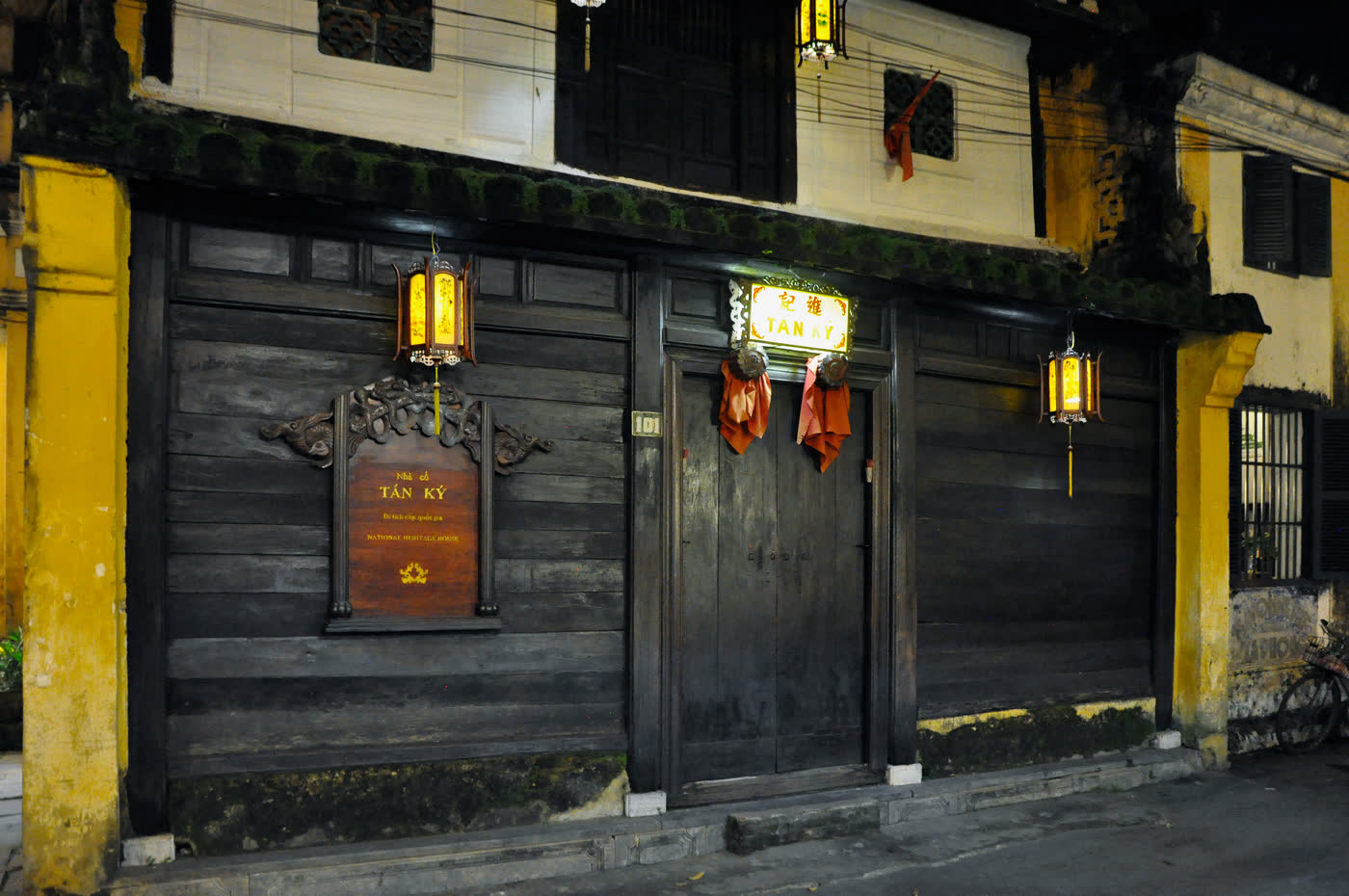

Before Nguyễn Thái Học Street
The street outside the door, called Tân Lộ under the Thiệu Trị reign, was not built until 1841. The family that owns the house told a visiting researcher it already stood there, put up sometime between 1800 and 1820 — more than twenty years before the road that now runs past its front door.
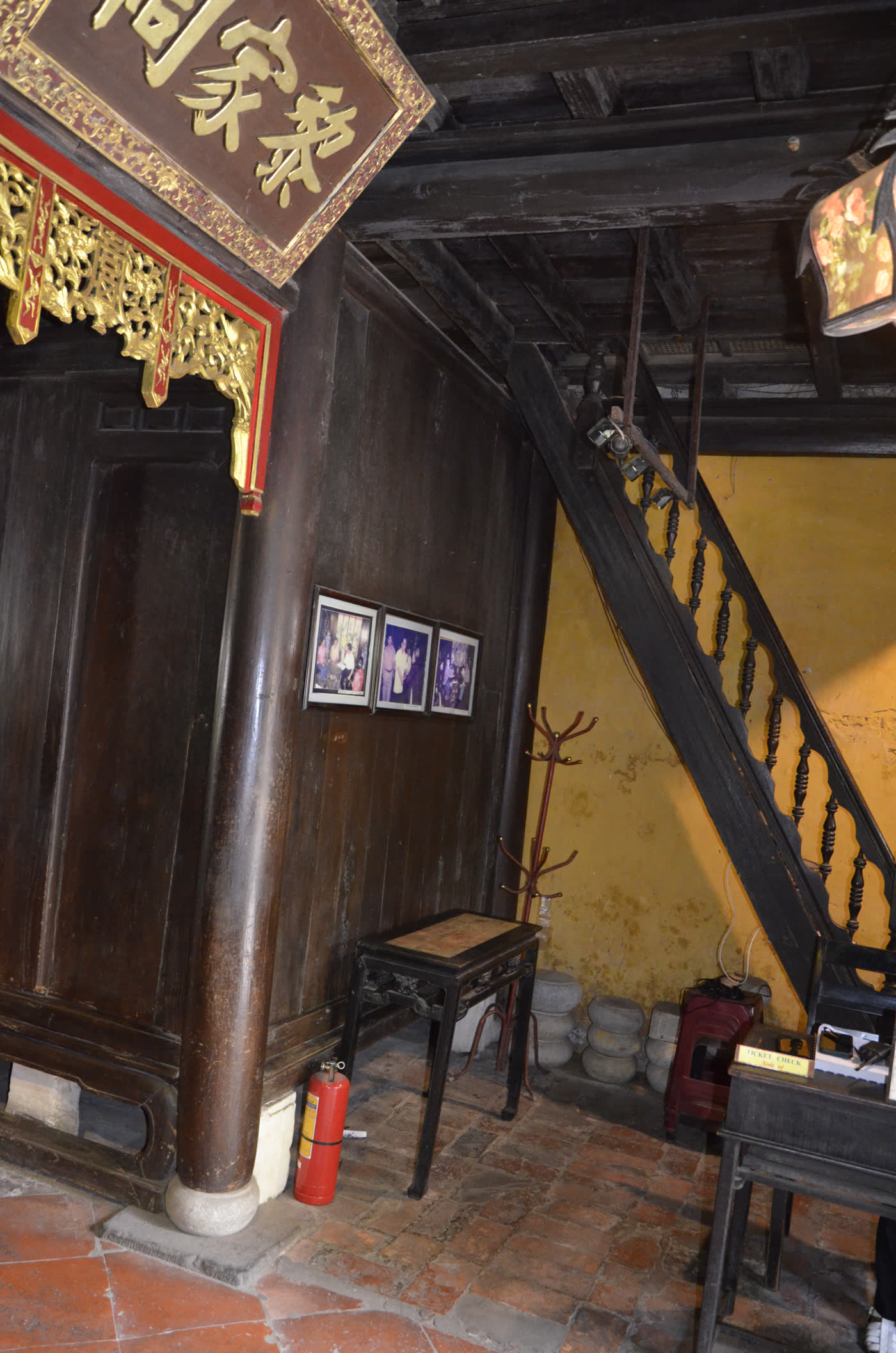
The family belongs to the Minh Hương community, descendants of Chinese settlers who took Vietnamese nationality in the seventeenth century. The house opened as a shop trading cinnamon and silk. A board still hangs near the ceiling of the front room, three gilt characters on a red ground: Lê Từ đường, the ancestral hall of the Lê family.
The trading sign hung at the centre of the house changed with each generation: Tấn Ký in the great-grandfather's time, then Tấn Bửu in the grandfather's, according to the family member who described the house in 2016. Seven generations of the Lê family have lived under its roof since. Lê Chương, the fifth-generation owner, died in 2010. Tân Xuân, of the sixth generation, still greets visitors and tells the house's story.
Four Sections, Thirty Metres
The house runs thirty metres back from the street in four linked sections, the tube-house plan Hội An people call nhà ruột ngựa, a horse-gut house. The front section rises two storeys under a moss-covered yin-yang tile roof. Its street face carries no windows, only a large timber door at the centre and two lattice openings pieced together from blue-glazed ceramic tiles shaped like flowers, drilled through to let air in. The family calls the style Japanese, adopted by Vietnamese builders — the kind once seen on houses in Hội An's old Japanese quarter.
 Photograph 2025 · YukioSanjo · Wikimedia Commons · CC BY-SA 4.0
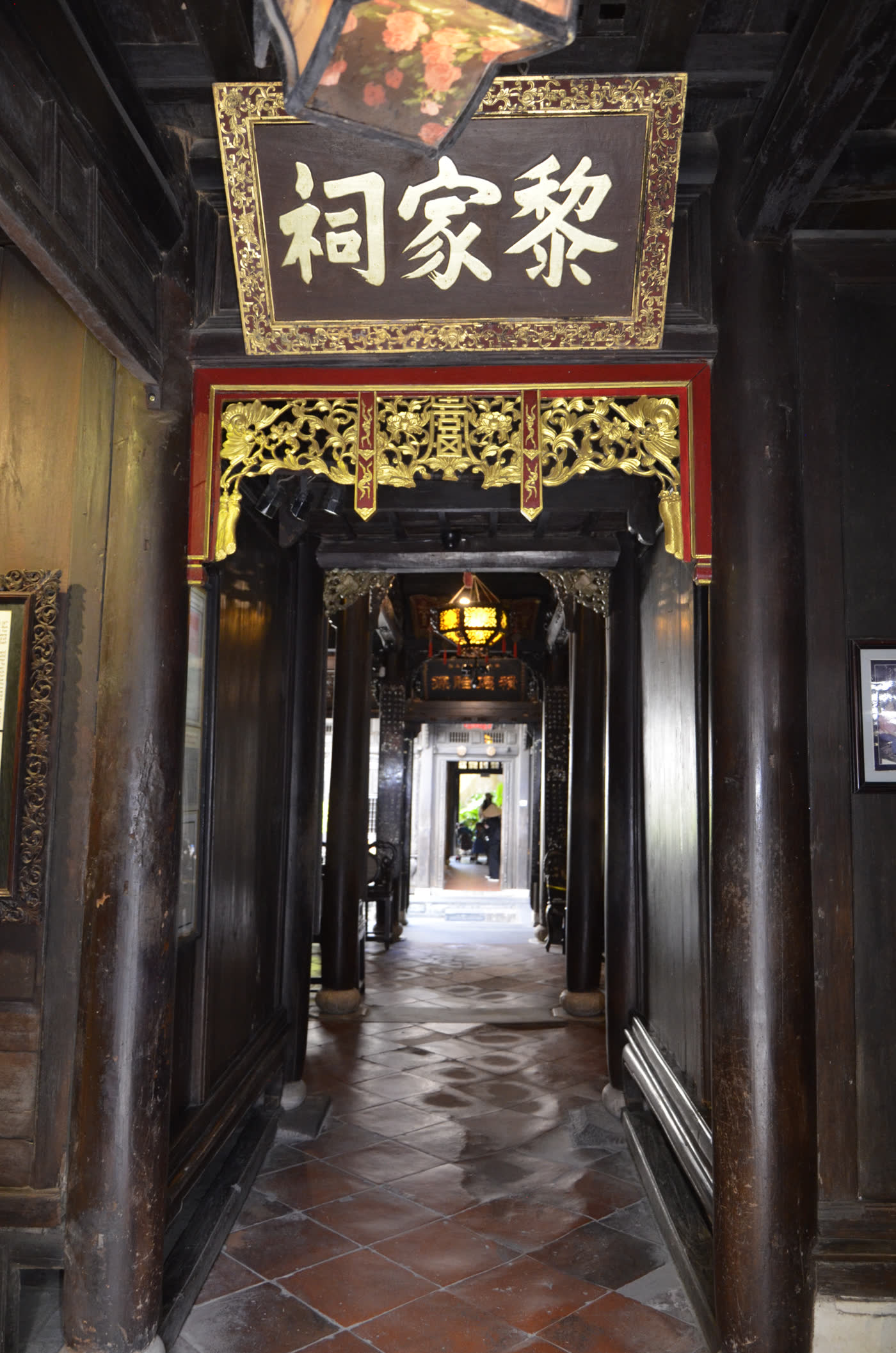
The second section once served as the shop floor, where the family struck deals with buyers. It now holds the family altar and a reception room. Its roof trusses stack short crossbeams in a Chinese style called chồng rường giả thủ. The columns are kiền kiền hardwood, resistant to rot, set on marble bases quarried at Non Nước mountain in Đà Nẵng. The floor is laid in Bát Tràng brick, carried down from the north. The walls are built in two layers, brick outside and timber within, keeping the room cool in summer and warm in winter.
 Photograph 2025 · YukioSanjo · Wikimedia Commons · CC BY-SA 4.0
Carpenters from Kim Bồng village, across the river, fitted the entire frame together with mortise and tenon joints. Not one nail went into it. They carved the timber with auspicious motifs: the eight treasures, plum and orchid and chrysanthemum and bamboo, dragon and unicorn and turtle and phoenix. Between the second and third sections sits an open well paved in grey stone slabs, the only place daylight and air reach a house with no side windows.
A Hundred Birds in Mother-of-Pearl
The house keeps several inscribed boards. Tích đức lưu tôn urges descendants to keep their virtue for later generations. Tâm thường thái urges a calm, steady heart. Best known is a pair of black lacquer couplets the family calls Bách Điểu, the Hundred Birds. Fourteen Chinese characters run down the boards, inlaid in mother-of-pearl, read as a hundred feet of willow catching rain that fell a thousand miles away, ten inches of bright moon lighting an entire loft of booksTHE COUPLET, IN SINO-VIETNAMESEBích xích thùy dương thiên lý vũ
Thập phân minh nguyệt nhất lầu thưThe source prints only the Sino-Vietnamese reading, not the original Chinese characters.báo Đô thị, 2010, đăng lại trên hoianworldheritage.org.vn. Around those fourteen characters run a hundred more inlaid figures of songbirds, a bird associated with the scholar-gentleman, each shown in a different pose: standing still, preening, wings spread, in flight.
 Photograph 2025 · YukioSanjo · Wikimedia Commons · CC BY-SA 4.0
Nearby sits a small cup tied to an old story about Confucius. Poured slowly, it fills evenly. Past a certain point the water drains out entirely through a hole hidden in the base.
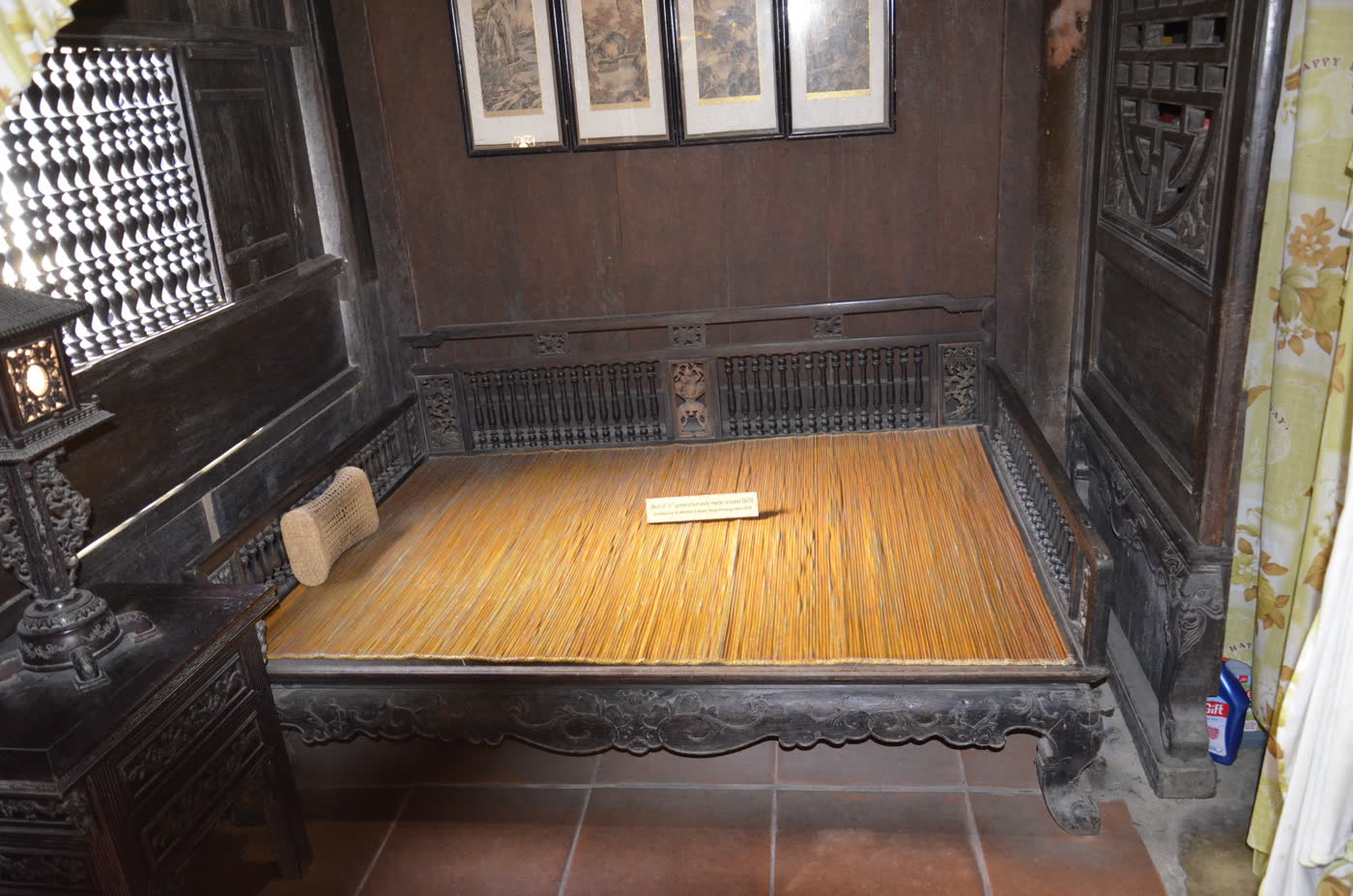
The house also keeps a pair of hexagonal lanterns painted with the Eight Immortals, Chinese merchandise once sold at Hội An's international trade fairs. A set of black lacquer furniture holds marble seats and tabletops from Ngũ Hành Sơn, alongside a set of ink-wash landscape paintings and a Chu Đậu ceramic vase from the sixteenth century, older than the house itself. All of it came into the family's keeping across later generations, not as part of the original build.
When the Street Was Riverbank
The rear of the house once stood flush against the riverbank, its back door opening straight onto the water where boats unloaded. Over the years the river silted up. Under the Tự Đức reign, in 1878, a new road was built into the gap between the house and the water's edge — Quảng Đông street, known today as Bạch Đằng.
Both ends of the house have a trapdoor in the ceiling opening onto a loft, and a pulley to haul goods up and down through it. In the years the shop still traded, cinnamon and silk moved this way from boats at the back door straight into storage. No load went up by hand.
 Photograph 2025 · Người Lao Động
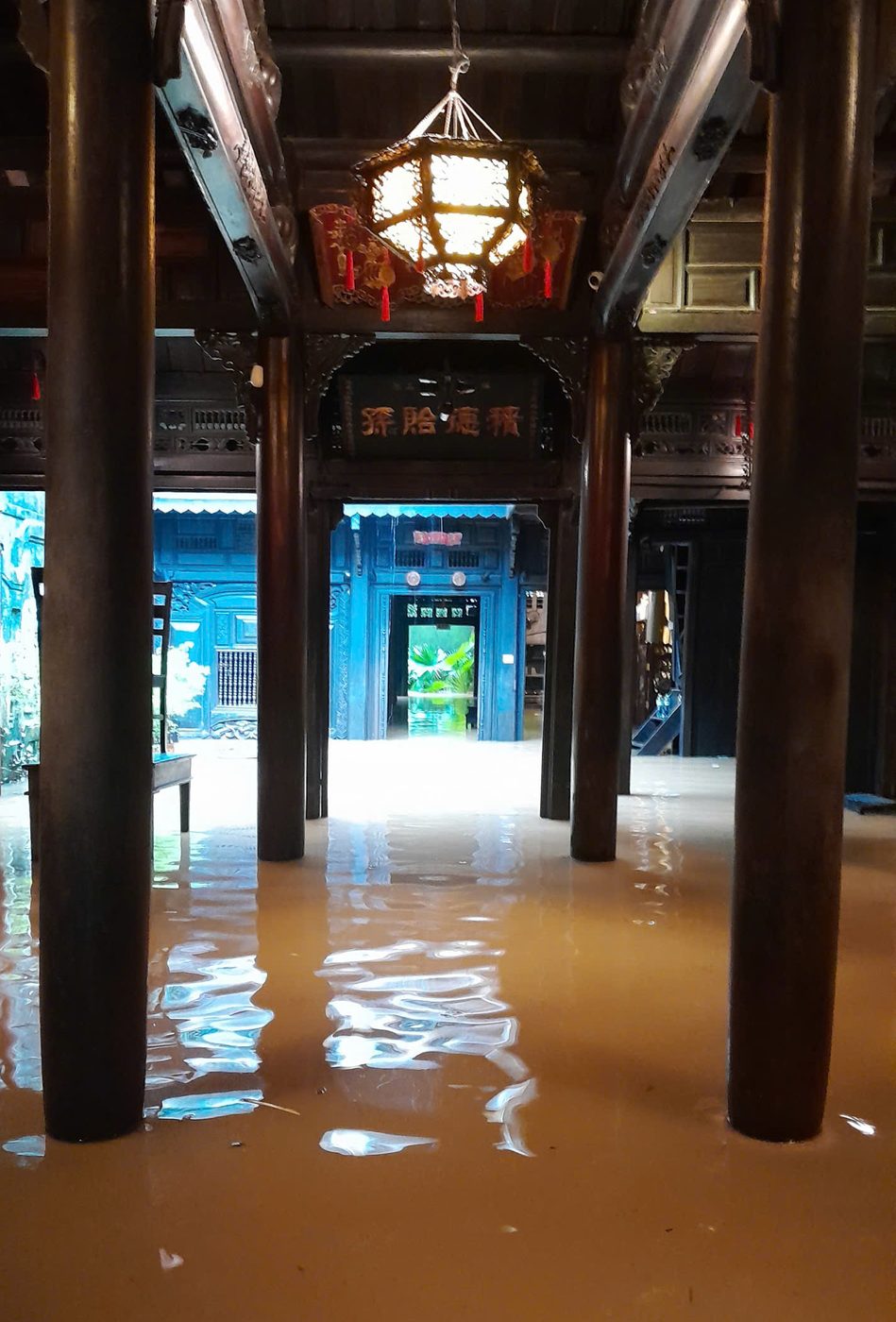
Hội An floods most years between September and December, when the Thu Bồn river rises, and the house at 101 Nguyễn Thái Học usually takes on one to two metres of water like the rest of the old quarter. In 1964 the water rose far past that, reaching the ceiling of the ground floor. The family cut that mark into a column, still the highest in a running record of flood years kept there.
Three floods struck the old quarter in close succession at the end of 2025. The owner added a line in pen below the 1964 mark, lower than it. Mud that flood left on the rear wall stayed untouched rather than washed off, so visitors after them could see how high the water had reached.
The First Private House
On 17 February 1990 the Ministry of Culture listed a group of Hội An sites as national relics on the same day: the old quarter as a whole, Chùa Cầu, the Fujian Assembly Hall, and Tấn Ký house.
Among that group, Tấn Ký was the first privately owned house in Hội An to receive national relic status — not a communal shrine or an assembly hall built by an entire community, but the home of one trading family.
Nine years later, in 1999, UNESCO added the whole old quarter to its World Heritage list. A house one family had built to trade from now stood listed among the heritage of everyone.
Someone Still Lives Upstairs
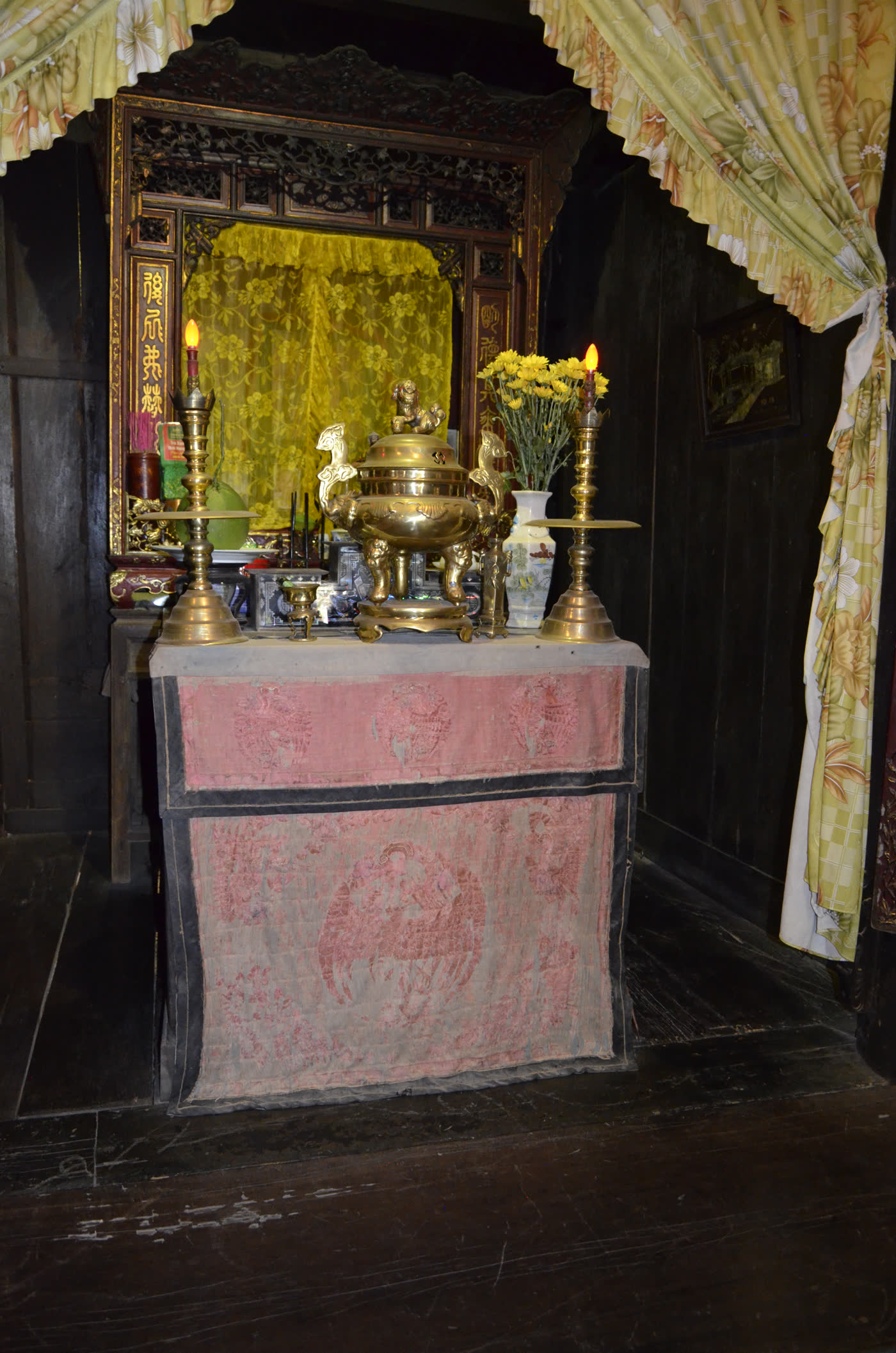
The ground floor is open to visitors today. The family still works upstairs each morning and returns to another home each evening. The ancestral altar keeps burning incense, and portraits of earlier generations still hang on the wooden wall behind it.
 Photograph 2025 · YukioSanjo · Wikimedia Commons · CC BY-SA 4.0
The house has hosted foreign heads of state and other visiting officials, and film crews have shot scenes inside it. A local guide says foreign visitors are drawn especially to the corner where flood photographs and the waterline marks are kept, curious how people in Hội An have lived alongside recurring floods.
A road that did not yet exist. A stretch of river that once reached the back step. Almost two hundred years later the road is a street and the river has retreated behind a row of houses. Only the house still stands exactly where it was.
- Nguyễn Phước Tương, "Ngôi Nhà cổ" — trích Đô thị cổ Hội An và những di tích tiêu biểu, tr. 129-137, NXB Giáo dục, 2007, đăng lại trên hoianheritage.net
- "Nhà Cổ Tấn Ký - Số 101 - Đường Nguyễn Thái Học - Phường Minh An" — Trung tâm Quản lý Bảo tồn Di sản Văn hóa Hội An
- Võ Hồng Việt, "Vì trính chồng trụ đội và vì vỏ cua trong kiến trúc gỗ Khu phố cổ Hội An" — Trung tâm Quản lý Bảo tồn Di sản Văn hóa Hội An
- "Chùa Cầu Hội An — Những lần tu bổ" — Trung tâm Quản lý Bảo tồn Di sản Văn hóa Hội An
- Trần Việt Anh, "Nhà cổ Tấn Ký, điểm dừng chân thú vị ở Hội An" — VnExpress, đăng lại trên hoianworldheritage.org.vn
- "Nhà cổ Tấn Ký Hội An" — báo Đô thị, đăng lại trên hoianworldheritage.org.vn
- Ngô Linh, "Nhà cổ hơn 280 tuổi không dùng đinh, bên trong nhiều cổ vật quý" — Dân Trí
- "Kho báu vật cổ vô giá trong ngôi nhà 283 tuổi nức tiếng Hội An" — VietnamNet
- Bích Vân - Trần Thường, "Hình ảnh dấu tích 3 trận lụt trên di sản phố cổ Hội An" — Người Lao Động
- Hoi An - Tan Ky Old House.jpg — P. Hughes (Indies1), CC BY 4.0