
A Basket That Holds No Rice
Hội An called it the thúng chai. The word was used from Quảng Bình south to the waterways of Nam Bộ, the southern region, and it meant a boat shaped like the round basket in which rice is carried. The hull was woven from bamboo, tied with rattan or nylon line, and sealed with resin oil, chai and buffalo or cow dung, by traditional methods. Trần Văn An, of the Hội An Cultural Heritage Management and Conservation Centre, set this out in an article dated 18 March 2024.
Pierre Paris, whose study of Vietnamese maritime ethnography Trần quoted, wrote that the boat was caulked with chai, a mixture of resin and buffalo or cow dung, and was called a thúng chai. He found it common from the coast at Đồng Hới to Vũng Tàu.
A basket, sealed watertight, became a boat.
Four Opinions, No Record
When did the thúng chai begin? Trần Văn An answered that no usable record existed. He listed four opinions and chose none of them.
The first was a legend about Trần Ứng Long, one of Đinh Tiên Hoàng's generals, who in 968 was said to have woven boats of bamboo and daubed them with tree resin to get his men across a river. Trần thought the legendary boat was probably a different kind of woven craft, and asked how many soldiers a single thúng chai could carry over. The second opinion made the thúng chai Cham in origin. He found no solid record for it and noted that the Cham rarely use the boat today. In a second article he quoted Inrasara on the sea craft of the Cham, which included a round boat called janưk patih, and regretted that Inrasara did not say how it was made.
The third opinion came from Ngô Văn Thanh of Phú Yên, who guessed that the boat appeared after the Nguyễn lords opened up the central coast, when fishermen had to launch through surf from open beaches. Ngô called it a guess and said he knew of no detailed study. The fourth held that fishermen devised the boat under French rule to avoid a boat tax charged by the width of the hull. Whoever said so gave no evidence.
In the end Trần would accept only that the thúng chai was an old craft of Hội An, Quảng Nam and Đàng Trong, the southern realm of the Nguyễn lords. The Chronicles go no further than he did.
A Photograph and a Book
The earliest dated trace in Trần's article is a photograph. Grossard photographed it in 1924, and the Musée du quai Branly – Jacques Chirac in Paris holds a print. Trần described the scene as what seemed to be a race of paddled thúng chai on a stretch of river.
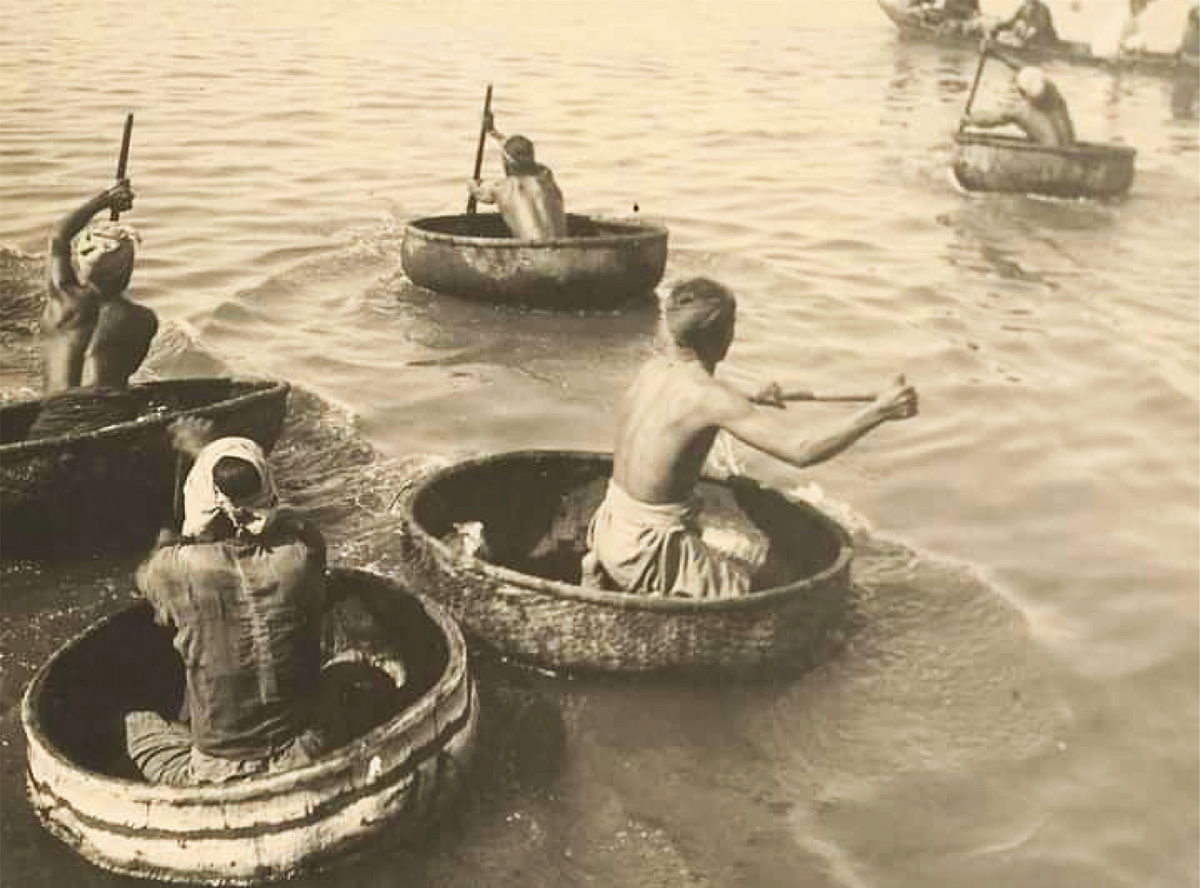 photograph · Grossard, 1924, Musée du quai Branly – Jacques Chirac (as reproduced on hoianheritage.net)
Nineteen years later J. B. Piétri gave the boat a passage in his book on Indochinese sailing craft, in the Vietnamese translation Trần quoted. Piétri called it the ghe thúng chai and wrote that it was found especially at the port of Đà Nẵng and spread from there along the coast. It was a round skiff about a metre across, sometimes a little more, light enough to run up a beach and small enough to stow on deck. Almost every Vietnamese line-fishing boat and trawler carried one.
He noted two more things. In parts of Bình Định, children moved the boat with a single flick of the hip. And in rough water around the coastal fishing boats, the work of setting hooks and lines and hanging nets fell to a boy in a thúng chai, who did it as lightly as if he were playing in the shallows.
The Boat That Rode Along
Trần listed the old jobs of the thúng chai. It carried goods and passengers from the shore out to ghe bầu, the sailing cargo boats, and to merchant ships, and back again. It rode aboard boats fishing far offshore for tuna and squid, and aboard trawlers that laid nets. It held salted fish. In storms, floods and other emergencies, Trần wrote, it gave effective protection.
He also described a morning on the beach at An Bàng and Phước Trạch, as the sun cleared the peak of Hòn Lao on Cù Lao Chàm. Small thúng chai came through breaking waves to the shore with fish, squid and crabs from the night's trip. Each carried one fisherman and one short paddle.
Bảy Mẫu and the Shake
On 28 May 2018 the newspaper Sài Gòn Giải Phóng described Cẩm Thanh, the commune beside the Bảy Mẫu coconut forest, as a poor village that lived off fishing and depended on the weather. In the rough season the city of Hội An had to organise famine relief. Then community ecotourism arrived. The commune chairman said that in the two hamlets running the boats, average income reached 31.5 million đồng a head in 2017. The province approved trial ticket sales in December 2017 and formal sales began in January 2018. In that first month more than 42,000 visits to the forest were ticketed.
Nguyễn Giang, aged 64, told the paper that after three months of rough sea the whole village would have gone hungry without the paddling. Lê Đình Bảy, aged 76, had given up fishing nets to paddle visitors and earned 300,000 to 400,000 đồng a day.
 photograph · Đà Nẵng Tourism Promotion Centre (danangfantasticity.com), 2025
The fleet grew with the visitors. The Hội An heritage centre counted 400 households and 918 tourist boats in Cẩm Thanh in 2018, and 1,200 boats in 2019. In 2022 Tuổi Trẻ News quoted the commune People's Committee as saying the number had jumped from a mere 30 to nearly 1,200 over several years. A resident recalled one international group for whom the village could muster only about 30 boats.
Shaking the boat for visitors became part of the Bảy Mẫu programme. In 2019, according to the newspaper Công Luận, the Korean beauty queen Ham So Won came with her family during a reality television programme, was thrown from the boat and fell into the water. The paper said the clip went viral. Tuổi Trẻ News wrote that once a reality show featuring a Korean beauty queen made the tours fashionable, more visitors came from South Asia. Neither article names the programme or the broadcaster in its text. A photograph in the Công Luận piece is credited only to “Flavor of Wife”.
Where the Weaving Survives
The weaving itself was thinning. At the end of 2020 Trần's survey team found a few households in Tam Thanh still weaving thúng chai for sale. By the time he wrote they had stopped, because the fishermen of Tam Thanh had moved to plastic boats. Across much of Quảng Nam, he added, Cù Lao Chàm included, fishermen now used mostly plastic ones, and the traditional craft had little footing left.
Cẩm Thanh was different. On 25 November 2023 the Centre launched its book on the boat, *Thúng chai ở Hội An*, six chapters and nearly 200 pages. Trần Quý, who ran a tourism business at Bảy Mẫu, said at the launch that most Cẩm Thanh boats were still woven of bamboo and only a few were industrial plastic. The newspaper Văn Hóa reported that Cẩm Thanh then had 1,393 thúng chai, of which 1,280 were carrying visitors in the Bảy Mẫu forest.
The weavers were elsewhere. On 26 May 2024 Văn Hóa described Hà Bình, a fishing village in Bình Minh commune, Thăng Bình district, inside the planned South Hội An zone. More than ten households there wove thúng chai for a living. They chose old bamboo, at least four years old, split it into strips and wove the shell. They plastered it with cow dung and let it dry, smoothed it, then coated it with resin oil and dried it again. The busiest season ran from the ninth lunar month to just before Tết, when rough seas kept boats ashore.
Nguyễn Văn Sinh, past seventy, had once fished far offshore from a thúng of his own weaving. After Typhoon Chanchu in 2006 killed many of the village's fishermen at the Hoàng Sa (Paracel Islands) grounds, he left the sea and went back to weaving for others. Each year he made at least about twenty line-fishing boats for crews working the Hoàng Sa and Trường Sa (Spratly Islands) grounds. Weavers in the village now also took orders from tourist sites at Tam Thanh, Bảy Mẫu and Cù Lao Chàm. Sinh's own view was that as long as fishermen worked the sea, weaving would survive in the fishing villages.
- Trần Văn An, Trung tâm Quản lý Bảo tồn Di sản Văn hóa Hội An, "Tản mạn thúng chai ở Hội An", 18/03/2024
- Trần Văn An, "Về nguồn gốc ra đời của thúng chai", hoiancreativecity.com
- Báo Văn hóa, "Ra mắt sách Thúng chai ở Hội An"
- Báo Văn hóa, "Nghề đan thuyền thúng ở Bình Minh", 26/05/2024
- Sài Gòn Giải Phóng, "Thoát nghèo nhờ… chèo thúng", 28/05/2018
- Tuoi Tre News, "Basket boat tours a refreshing breeze in Vietnam's Hoi An", 15/04/2022
- Báo Công luận, "Quay thuyền thúng, trò chơi cực chill của du lịch Quảng Nam"
- Nghề làm nhà tre dừa ở Cẩm Thanh (danangfantasticity.com) — Trung tâm Xúc tiến Du lịch Đà Nẵng, chưa rõ, dùng có ghi công