
What the Town Tells
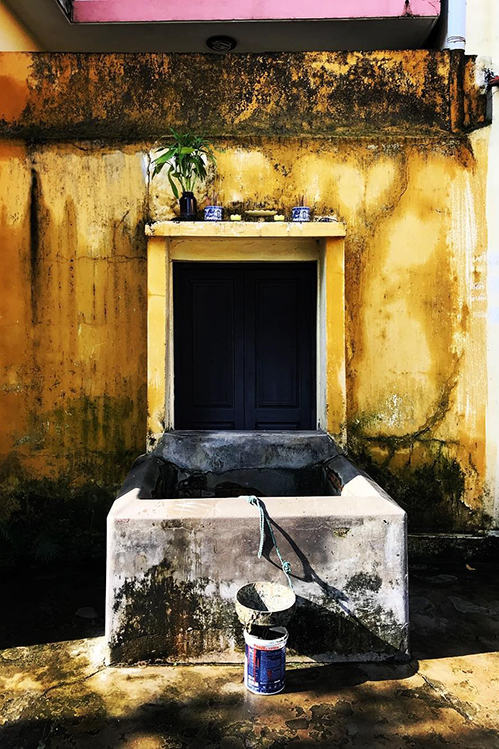
In Minh An ward a narrow alley runs between Phan Châu Trinh street and Trần Hưng Đạo street. People in the old quarter call it kiệt Bá Lễ, the Bá Lễ alley. A square brick well stands at its centre, its rim rising 0.8 metres above the ground under a cement render. Anyone who needed water simply drew it, from any house.
The story the town tells goes back to Champa times, the eighth or ninth century, when Persian and Arab traders were said to put in at the river mouth for fresh water before sailing on. That is how the story is told, and no one in Hội An today remembers what the well was called before that.
The name the well carries now dates only from the century after.
Brick Without Mortar
The Hội An Heritage Management Centre's own record for the well gives its footprint as 20 square metres and its depth as 4 metres. A square ironwood frame at the bottom carries Cham-style brick above it, laid without mortar.
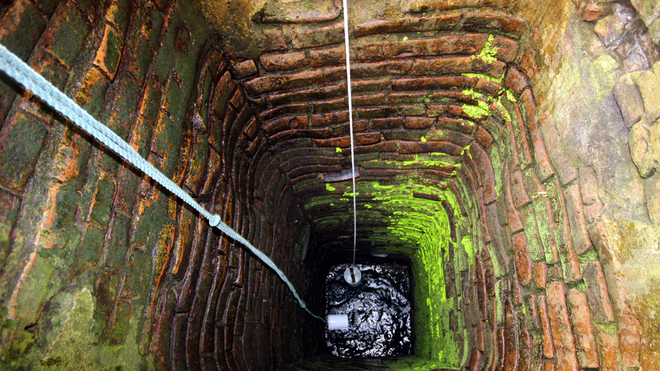 Photograph 2018 · Sơn Thủy · VnExpress
The bricks sit stacked without any binding agent, and the gaps between them let groundwater seep straight into the shaft, so that drawing water off only draws more up to replace it. On the well's age, the Centre's own survey holds back. No written record has ever turned up that fixes a date. The square shape common across the old quarter may equally be a Vietnamese builders' technique copying a Cham model, not proof a Cham hand ever laid a single brick of it.
In 2016 a team led by Tôn Thất Hướng, of the provincial department of culture, excavated a different square brick well elsewhere in Quảng Nam province, beside Cham steles and statues, and dated it to around the twelfth century. The technique matched. The well did not.
The well in the Bá Lễ alley still has no date of its own, only what people say of it.
More Than Eighty Wells in One Small Town
Bá Lễ is not the only old well in Hội An. The Heritage Management Centre has surveyed more than eighty of them across the town, sorted into three basic shapes: round wells are the most common, then square ones, then a hybrid with a round upper section over a square base. Round wells dominate on the town's edges. Inside the old quarter itself, the square and hybrid shapes turn up far more often.
Most of the wells stand close to old watercourses, some no more than a dozen paces from the bank. Even hard against stretches of river running brackish, the wells hold fresh water through the driest spells, by the same unmortared brick that Bá Lễ uses. A number of them still stand inside the courtyards of assembly halls, communal shrines and clan houses built by the town's Minh Hương and Ngũ Bang Chinese communities.
Not far off, a stone-lined well in Trà Quế, the vegetable-growing village, is said to date to the same Cham period and still irrigates the fields there. On Cù Lao Chàm island, the well at Xóm Cấm hamlet uses the same method, brick-lined with an ironwood frame. It has never run dry either.
Eighty wells, three shapes, one method for holding fresh water in salt ground.
A Woman Who Paid a Hundred Piastres
By the early twentieth century the well had fallen into disrepair. A woman who lived nearby, known in the neighbourhood as Bá Lễ, paid 100 đồng, Indochinese piastres, to have it rebuilt.
A hundred đồng was real money at the time. The repair finished, and people in the quarter simply began calling it the Bá Lễ well, in place of the nameless well that had stood there long before she was born.
A well with no name of its own came to carry the name of the woman who saved it from ruin, not the name of whoever first dug it.
Water for Cao Lầu
The water runs clear and sweet, and people who cook in the old quarter say no other water gives cao lầu or mì Quảng noodles quite the same taste.
Cao lầu, mì Quảng, sweet soups, bánh bao bánh vạc dumplings — the town's signature dishes all lean on water carried up from this well, not from the mains that have run to every house for years. Street vendors and small kitchens still send someone out each morning to fetch it.
On Nguyễn Thái Học street, the way in from the alley, one household keeps a jar of well water out with a handwritten note: water for visitors. Travellers passing by stop to taste it, free of charge.
One well, and an entire cuisine built on what it gives.
A Shoulder Pole Worn Smooth
Nguyễn Đường and his wife Nguyễn Thị Mỹ drifted into Hội An before 1975. A neighbour gave them a scrap of land to put up a shelter. Seeing how much the town prized water from the Bá Lễ well, the couple began carrying it to sell.
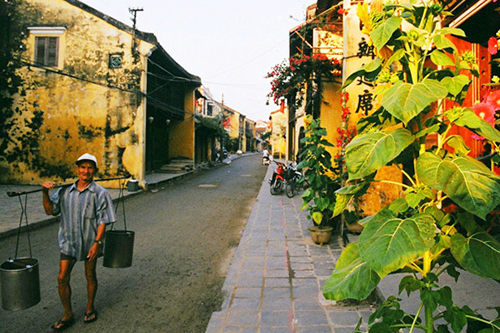 Photograph 2018 · Vũ Minh Quân · VnExpress
The couple had one son, Quốc, frail from childhood, quiet and gentle by nature. He took over the carrying once his parents' legs gave out, walking water from house to house, and on the first and fifteenth of each lunar month he still brings incense and flowers to a grave nearby, a habit he has kept up for years.
On 4 December 2014 the Vietnam Records Organisation travelled to Hội An to certify Nguyễn Đường as the country's longest-serving water carrier. Others worked the same trade alongside him — Trần Trung Mẹo hauled sixty to seventy twenty-litre jugs a day, charged a few thousand đồng a jug, and cleared no less than 150,000 đồng.
A shoulder pole worn smooth, bowed with the years, still crosses the same lanes every morning.
Water to Drink, Not to Wash
About half a metre above the water sits a small shelf. People leave a bowl for incense there, a potted plant, sometimes fruit. Nguyễn Chí Trung, director of the Heritage Management Centre at the time, once put it this way: this is a matter of belief among people of the old quarter, who hold that every well has a guardian spirit, which is why its water stays clear and cool the year roundAS THE DIRECTOR PUT ITĐây là một yếu tố tâm linh của cư dân phố cổ. Họ quan niệm rằng mỗi chiếc giếng có một vị thần bảo hộ nên nguồn nước mới được trong mát quanh nămNguyễn Chí Trung, giám đốc Trung tâm QLBT Di sản Văn hóa Hội An (2011).
Lê Thị Hiểu, ninety-three years old and a lifelong resident nearby, described a rule that goes with the well: its water is for drinking only, never for washing. Anyone caught doing laundry there paid a fine on the spot.
A well that supplies water to the whole quarter, and still not water anyone may use however they like.
Can a Well Run Thirsty
In 2007 a reporter for the newspaper Công an Nhân dân travelled to the Bá Lễ alley, tasted the water, and filed a piece with a different tone from the usual praise: a warning that the well was being drawn on too hard.
Water carriers were growing more numerous, and motorbikes and handcarts hauled jugs out across the quarter from early morning to dusk. Reinforced-concrete houses had gone up hard against the rim, and the article worried that their drains and septic pits might taint the water table underneath. It raised a second question too: keep drawing on the well this hard, and would it eventually run dry.
Close to twenty years have passed since that article ran, and the Bá Lễ well has not run dry yet.
The Well Still Stands
In 2021, in the middle of a long Covid outbreak, reporters for the newspaper Đại Đoàn Kết went back to the Bá Lễ alley and found the well nearly empty of visitors, with only the odd resident stopping to draw water. A bilingual sign still stood beside it, reading GIẾNG BÁ LỄ and BA LE WELL, fixed against an orange-painted wall.
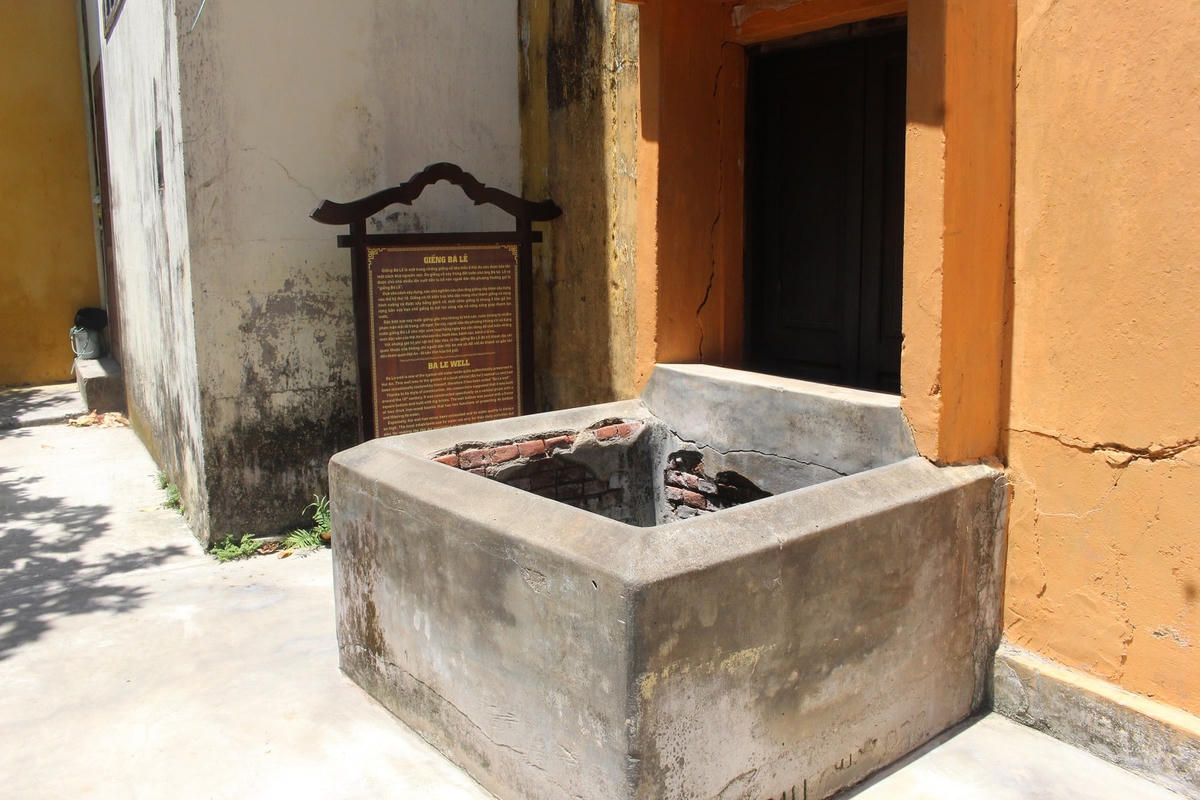 Photograph 2021 · Tấn Thành - Chí Đại · Đại Đoàn Kết
Xóm Cấm on Cù Lao Chàm island carries its own national heritage listing, granted in 2006. Bá Lễ is the better known of the two wells, in local memory and in the press, but the Chronicles has not been able to locate any document that lists it as a national monument in its own right.
People still come out to draw water each morning, the same as before the sign went up, before the well had the name Bá Lễ, before anyone alive remembers it being dug at all.
- "Giếng Bá Lễ - Đường Trần Hưng Đạo - Phường Minh An" — Trung tâm Quản lý Bảo tồn Di sản Văn hóa Hội An
- "Giếng cổ ở Hội An" — Trung tâm Quản lý Bảo tồn Di sản Văn hóa Hội An
- Hồng Việt, "Vấn đề khai thác và sử dụng nguồn nước ngọt của cư dân Hội An trong lịch sử" — Trung tâm Quản lý Bảo tồn Di sản Văn hóa Hội An
- "Giếng Xóm Cấm - Thôn Cấm - Xã Tân Hiệp" — Trung tâm Quản lý Bảo tồn Di sản Văn hóa Hội An
- "Giếng Đá Trà Quế - Thôn Trà Quế - Xã Cẩm Hà" — Trung tâm Quản lý Bảo tồn Di sản Văn hóa Hội An
- "Giếng cổ Bá Lễ" — Cổng thông tin Phố cổ Hội An - Di sản văn hóa thế giới
- "Giếng Cổ Bá Lễ" — Cổng thông tin Phố cổ Hội An - Di sản văn hóa thế giới
- Lưu Hoàng Anh, "Kỳ tích bên giếng cổ Bá Lễ" — báo Công an Đà Nẵng
- "Giếng nghìn năm tuổi và người gánh nước thuê lâu nhất ở Hội An" — VnExpress
- Hoài Thu, "Giếng Bá Lễ ở Hội An (Quảng Nam): Nỗi lo 'giếng khát'" — báo Công an Nhân dân
- Diệu Hiền, "Kỳ bí giếng cổ: Giếng cổ Hội An không bao giờ cạn" — báo Thanh Niên
- Tấn Thành - Chí Đại, "Đìu hiu giếng cổ Hội An" — báo Đại Đoàn Kết
- "800-Year-Old Brick-Lined Well Discovered in Vietnam" — Archaeology Magazine